A roofing answering service is a team of people who pick up your calls when you can’t, take a message and pass it on. An AI receptionist does a similar job with software: it answers calls, texts and website chats, asks the right questions and can book the inspection on your calendar. Both stop the phone from going to voicemail. They differ in how fast they respond, how many calls they can take at once, what they can actually do with a lead, and how you pay for them. This guide goes through the seven differences that matter most to a roofing company, so you can pick the right one, or a mix of both.
Key takeaways
- Both options beat voicemail. A homeowner with a leak usually calls the next roofer rather than wait for a callback.
- A human answering service is good at calm, personal conversations. Most take a message rather than book the job.
- An AI receptionist answers every call, text and chat at once, follows your booking rules and can put inspections straight on your calendar.
- Storm days are the real test. A service with a fixed number of agents can fill up; software does not.
- Many roofers use both: AI for speed and booking, a person for urgent or complex calls.
In this guide
What do an answering service and an AI receptionist each do?
A traditional answering service is a call center. When your line rings out or you are closed, the call forwards to an agent who answers in your company name, follows a short script, takes the caller’s details and sends them to you by text or email. Some services can also book appointments if you give them access to a calendar and clear rules.
An AI receptionist for roofers answers by voice, text and chat. It is set up with your services, service area, hours and booking rules. It can answer common questions, collect the address and the problem, book an inspection, send the details to you straight away, and pass urgent calls to your on-call person.
Both solve the same first problem: a homeowner calls while your crew is on a roof or the office is closed, and nobody picks up. The differences show up in what happens next.
What are the 7 differences between an AI receptionist and an answering service?
1. Speed to answer
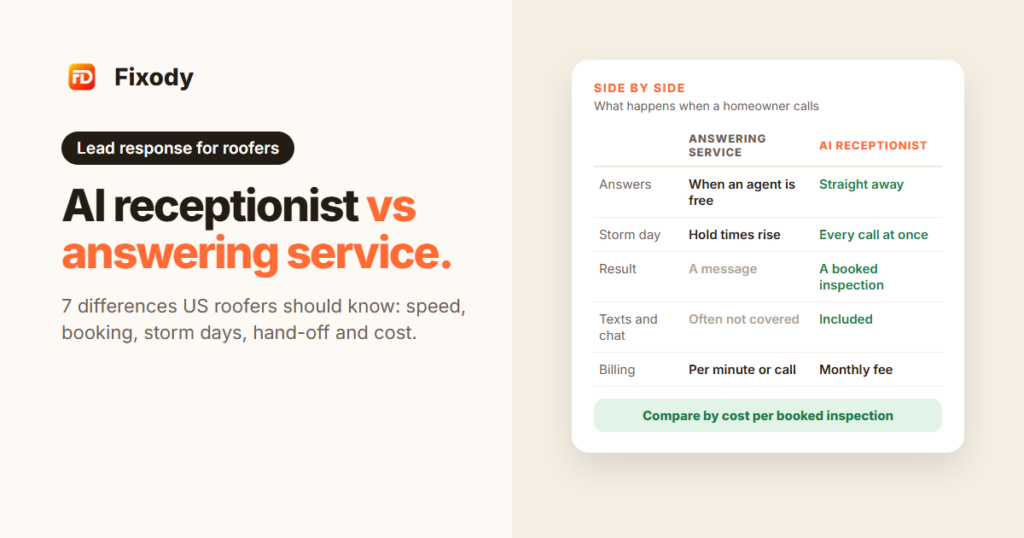
An answering service answers when an agent is free. On a quiet afternoon that can be quick. When many of the service’s clients get calls at the same time, callers may wait on hold.
An AI receptionist picks up straight away, every time, and can text back a missed caller within seconds. For roofing leads, speed matters: a homeowner with water coming through the ceiling rarely waits long before calling someone else. Our missed-call text-back guide covers the texts that go out in that first minute.
2. Storm-day capacity
This is the difference roofers feel most. After a hail or wind storm, calls arrive in waves: dozens in an hour, then hundreds in a week. An answering service has a set number of agents, and they also cover other businesses hit by the same storm. Hold times go up and some callers hang up.
An AI receptionist answers every call at once, however many come in. It can sort them by urgency, book inspections into the open slots you set, and text the rest a clear next step so nobody is left waiting without an answer.
3. Booking into your calendar
Most answering services take a message: name, number, address, what the caller said. Someone at your office still has to call back and book the inspection, and by then the homeowner may have booked with another roofer.
An AI receptionist can book the inspection during the call or text, using your real calendar and your rules: which towns, which days, how far apart jobs are, and which jobs need a manager to approve. The homeowner hangs up with a time, not a promise of a callback.
4. What it knows about your business
An agent at an answering service works from a script and a short sheet of notes about your company. They can tell callers your hours and take a message, but most can’t answer detailed questions about your roofing materials, warranties or whether you handle insurance claims.
An AI receptionist is set up with your own information and gives the same answer every time. It should only answer what you have approved and pass anything else to a person.
5. Hand-off to a person
Some calls need a human: an angry customer, an active leak in a storm, a commercial property manager with a large job, or someone who simply asks for a person.
With an answering service, the caller is already talking to a person, which is a real strength. The agent still has to reach someone at your company for anything beyond a message.
A good AI receptionist hands over whenever the caller asks or the call meets your rules for urgency, and sends the details ahead so your on-call person does not start from zero. If a setup makes it hard to reach a human, homeowners notice, so test this part before you go live.
6. Texts, chat and quote forms
Homeowners don’t only call. Many text, fill in a quote form on your website or send a chat message at 10 pm. Most answering services only cover the phone.
An AI receptionist covers calls, texts, website chat and quote forms in the same way and books from any of them. Every lead gets a reply within minutes, whichever way it came in.
7. Cost model
Answering services usually charge by the minute or by the call, often with a monthly plan that includes a set number of minutes and fees for anything over. That means your bill rises in your busiest weeks, right after a storm.
AI receptionists are usually billed as a monthly fee, sometimes with usage charges for very high volume. The cost per call tends to fall as call volume rises. The next section compares them side by side.
How do the costs compare?
Prices vary by provider, region and volume, so compare quotes on the same basis. This table shows how each option is usually billed and what drives the cost:
| Cost factor | Answering service | AI receptionist |
|---|---|---|
| How it is billed | Per minute or per call, often in monthly minute bundles | Monthly fee, sometimes with usage charges at high volume |
| Storm week | Bill rises with every extra call and minute | Little or no change for most plans |
| Setup | Script and message rules, usually quick | Services, area, booking rules and calendar connection; takes longer up front |
| Booking the job | Often extra, or your team books on callback | Included when the calendar is connected |
| Texts, chat and forms | Often not covered, or extra | Usually included |
| Hidden cost | Leads lost while waiting for a callback | Time to set up and review answers each month |
The fairest comparison is cost per booked inspection, not cost per call. Add up what you pay in a month, then divide it by the number of inspections that actually ended up on your calendar from those calls.
A missed call can also cost you more than the job. If you run Google Local Services Ads, Google says a missed call during your business hours can still count as a lead you pay for if the caller stays on the line long enough. Google also says that if you regularly fail to answer calls or respond to messages, your ad ranking may be affected.
Which one fits your roofing company?
Use this as a quick guide:
| Your situation | Better fit |
|---|---|
| Low call volume, and you just need someone polite to take messages after hours | Answering service |
| You want inspections booked, not just messages taken | AI receptionist |
| You work storm markets and call volume spikes | AI receptionist |
| Many of your leads come in by text, chat or website form | AI receptionist |
| Many calls are complex commercial jobs or sensitive insurance disputes | A person, with AI covering overflow and after hours |
| You run emergency repairs at night and on weekends | Both: AI to answer and sort, a person on call for true emergencies |
How can roofers use an AI receptionist and a person together?
For most roofing companies the best setup is not one or the other. Here is how it can work at Example Roofing Co.:
- The office answers first during business hours when someone is free.
- The AI receptionist answers when the office is busy, after hours, on weekends, and on every text, chat and quote form.
- Every missed call gets a text within seconds, so the homeowner knows they have been heard.
- Routine jobs are booked straight onto the calendar using the company’s rules.
- Urgent or complex calls go to a person: the on-call manager gets the details and calls back fast.
- Every estimate gets a follow-up after the inspection, through estimate follow-up texts and emails.
Whatever you choose, test it like a homeowner would. Call your own number after hours, during a busy hour and on a weekend. Send a text and fill in your quote form. Note how long each reply takes and whether you end up with a booked time or just a promise of a callback.
If you’d like a second opinion on your setup, book a 15-minute call with us. We will look at how your calls are handled today and quote the setup that fits your volume. The AI front desk is part of each of our roofing marketing programs.
Frequently asked questions
What is a roofing answering service?
It is a call center that answers your phone in your company name when you can’t, takes the caller’s details and sends them to you. Some can also book appointments if you give them calendar access and clear rules.
Is an AI receptionist better than an answering service for roofers?
For speed, booking and storm-day volume, usually yes. A human answering service can be better for sensitive or complex calls. Many roofers use AI for most calls and pass urgent ones to a person.
Will homeowners know they are talking to AI?
A good AI receptionist is clear and polite about what it is, and hands over to a person whenever the homeowner asks or the call needs one.
Can an AI receptionist handle roof leak emergencies?
It can collect the address and the problem, then pass the call to your on-call person straight away, following your rules for what counts as urgent.
How much does a roofing answering service cost?
Most charge per minute or per call, often with monthly minute bundles, so the bill rises in busy weeks. AI receptionists are usually a monthly fee. Compare them by cost per booked inspection, not cost per call.
Do I need a new phone number?
Usually not. Both options normally work by forwarding calls from your existing business number.
Can I keep my office staff answering calls?
Yes. Your team can answer first, with the AI receptionist covering busy times, after hours, weekends, texts and web forms.
Sources
- Google Local Services Ads Help: How leads work
- Google Local Services Ads Help: Getting started with Local Services Ads (United States)
How many of your calls are going unanswered?
The free lead-leak report tests how fast your business answers calls, texts and quote forms, checks your Google Business Profile, website and reviews, and shows which fixes will bring in the most jobs first.