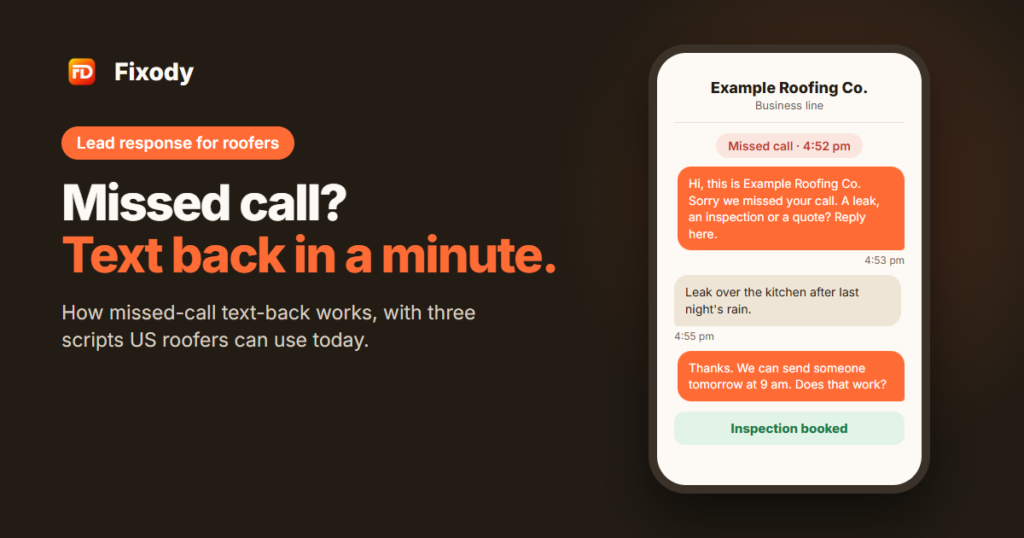
Missed call text back for roofers is a simple automation: when a call to your business goes unanswered, the caller gets a text from your company number within about a minute. The text says who you are, that you saw the call, and how to get help. The homeowner can reply right away, and that reply becomes a conversation your office can pick up. Its job is to stop a missed call from becoming a lost job. This guide explains how the setup works, gives three scripts you can adapt, and shows where text-back fits alongside answering the phone live.
Key takeaways
- A homeowner who reaches voicemail often just calls the next roofer on the list. A fast text keeps the conversation with you.
- The text goes out automatically from your business number, usually within a minute, and every reply should reach a real person on your team.
- Good scripts are short, use your company name, ask one easy question and give an urgent-leak option.
- Text-back is a safety net, not a replacement for answering calls live. Use it after hours, during busy spells and when crews or the office cannot pick up.
- Keep it to replies to people who called you. Marketing texts need separate consent, and every text should honour STOP requests.
In this guide
Why do missed calls cost roofers jobs?
Most homeowners who call a roofer have a reason to call now: a leak, storm damage, a failed inspection or a quote they need before they list the house. If nobody answers, few leave a voicemail and wait. They go back to the search results and call the next company.
Roofing companies miss calls for ordinary reasons. The owner is on a roof. The office manager is on another line. A storm sends call volume up all at once. Calls come in at 7 pm, on Saturday morning or over a holiday. None of this means the business is careless, but each unanswered call is a homeowner who may never call back.
Missed-call text-back does not save every one of those calls. It gives each caller a reason to stay with you instead of moving on.
How does missed-call text-back work?
The system sits on your business phone line. When a call is not answered, or goes to voicemail, it sends a text from the same number the homeowner dialled. Here is the flow for a typical roofing company:
| Step | What happens | Who does it |
|---|---|---|
| 1. Call comes in | A homeowner calls your business number | Homeowner |
| 2. Call is missed | Nobody picks up within the set number of rings, or the call goes to voicemail | Phone system |
| 3. Text goes out | An automatic text from your business number arrives within about a minute | Automation |
| 4. Homeowner replies | They say what they need: a leak, an inspection, a quote, a question | Homeowner |
| 5. Team is alerted | The reply lands in a shared inbox and someone on the team gets a notification | Automation |
| 6. Person follows up | Someone texts back or calls, answers the question and books the inspection | Your office |
| 7. Lead is logged | The caller, their reply and the outcome are saved so nothing is lost | Automation |
The automated part is short: one text out, then a hand-off to a person. The value comes from steps 5 and 6. If replies sit unread for hours, the homeowner gets the same experience as an unanswered call.
Three text-back scripts for roofers
These scripts use Example Roofing Co. as a placeholder. Swap in your company name and keep the tone the way your office really talks. Short is better: most homeowners read these on a phone, often standing in a room with a wet ceiling.
Script 1: Missed call during business hours
Hi, this is Example Roofing Co. Sorry we missed your call. We’re on another line or out on a job. What can we help with: a leak, an inspection or a quote? Reply here and we’ll get back to you shortly.
Use this when the office is open but busy. It explains why nobody answered, without excuses, and asks one easy question with three choices.
Script 2: After hours or on the weekend
Hi, this is Example Roofing Co. Thanks for calling. Our office is closed right now, but we got your call. If you have an active leak, reply LEAK and we’ll call you as soon as we can. For anything else, reply with what you need and we’ll be in touch first thing tomorrow morning.
After hours, the honest promise is the next business morning. Only offer a faster call-back on urgent leaks if someone on your team is really on call. If nobody is, leave that line out.
Script 3: Storm surge or peak season
Hi, this is Example Roofing Co. We’re getting a lot of calls after the storm and missed yours. We’re booking roof inspections in the order requests come in. Reply with your address and what you’re seeing (missing shingles, a leak, dents on vents or gutters) and we’ll text you a time.
During a storm, the phone cannot keep up. This script sets a fair expectation and collects what your team needs to schedule the inspection. It also helps you sort true leaks from routine checks.
A few rules that apply to all three scripts:
- Name your company in the first words. The homeowner may have called five roofers.
- Ask one question. A reply is easier when the choice is simple.
- Do not promise times you cannot keep. “Shortly” or “first thing tomorrow” is better than a ten-minute promise you miss.
- Skip links and prices. The goal of the first text is a reply, not a sale.
How does text-back work alongside live answering?
A homeowner with a roof problem would rather talk to a person. Text-back is the backup for the calls you cannot answer, not a reason to stop picking up. Most roofing companies get the best result from a mix:
| Situation | Best first response | Role of text-back |
|---|---|---|
| Office open, line free | Answer live | Not needed |
| Office open, all lines busy | Answer live where possible | Catches calls that ring out |
| Owner or estimator on a roof | Forward to the office if it is staffed | Catches the call if nobody can pick up |
| Evenings and weekends | Answering service or on-call person, if you have one | Main response if nobody is on call |
| Storm surge | Answer as many calls as you can | Collects addresses and damage details for scheduling |
Some roofers pair text-back with an AI receptionist that answers calls and books inspections when the team cannot. Either way, the principle is the same: every caller should hear from you fast, and every conversation should end up with a person who can book the job.
How do you set up missed-call text-back?
The setup is the same whatever phone tools you use:
- Use your main business number. The text should come from the number the homeowner called, so the reply goes to the right place and the homeowner recognises it.
- Decide when a call counts as missed. For most roofers, that is a call nobody answers within four or five rings, or one that goes to voicemail.
- Load your scripts. Set a business-hours script, an after-hours script and a storm script you can switch on when needed.
- Route replies to people. Send replies to a shared inbox the office checks all day, plus a phone notification for the owner or the person on call.
- Agree a reply target. For example, every text reply gets a human response within 15 minutes during business hours. Write it down so everyone knows.
- Log every lead. Save the caller, the reply and the outcome in your CRM or job management tool, so missed calls do not disappear.
- Add follow-up. If the homeowner gets an estimate, a follow-up sequence keeps the quote from going cold. Our estimate follow-up service covers that next step.
- Test it. Call your own number from a personal phone, let it ring out and check that the text arrives, the reply reaches the team and the lead is logged.
Business texting in the US runs through registration programs at the wireless carriers, so allow time for your number to be approved before you go live. Your phone or texting provider will handle the registration with you.
What texting rules should roofers follow?
Missed-call text-back is a reply to someone who just tried to reach you, which is different from sending marketing texts to a list. Industry guidelines from CTIA, the wireless trade group, treat messages where the consumer reaches out first and the business simply responds as conversational messaging. The same guidelines say businesses should act on opt-out words such as STOP.
The FCC’s rules on automated texts are stricter. The FCC says callers need the consumer’s consent before sending an autodialed call or text to a wireless number. In practice, that means:
- Use text-back only to reply to people who called you.
- Do not add callers to promotional text campaigns unless they have agreed to receive them.
- Stop texting anyone who replies STOP, or anything similar.
- Identify your company in every message.
This is general guidance, not legal advice. Rules change and some states add their own, so check your setup with your provider and, if in doubt, a lawyer.
How can you tell whether text-back is working?
Track a few simple numbers each month:
| Metric | What it tells you |
|---|---|
| Missed calls | How many calls nobody answered, and at what times |
| Texts sent | Whether the automation fired on every missed call |
| Reply rate | How many homeowners replied to the text |
| Time to human reply | How fast your team picked up the conversation |
| Inspections booked | How many replies turned into a booked appointment |
| Jobs signed | The revenue that came from calls you would otherwise have lost |
The missed-calls number is useful on its own. If most missed calls land at the same times, such as early morning, lunch or after 5 pm, that tells you where live answering cover would help most.
If you want the whole system done for you, our AI front desk service sets up missed-call text-back, call answering and booking for roofing companies. It is part of our roofing marketing programs.
Frequently asked questions
What is missed call text back for roofers?
It is an automation that sends a text from your business number to anyone whose call you did not answer. The text names your company, asks what they need and passes their reply to your team, so the caller does not move on to another roofer.
How fast should the text go out after a missed call?
Within about a minute. The homeowner is still holding the phone and deciding who to call next, so a text that arrives straight away has the best chance of a reply.
Does missed-call text-back replace answering the phone?
No. Homeowners with a roof problem would rather talk to a person. Text-back is a backup for calls you cannot answer, such as after hours, during storms or when the office is busy.
Can I send marketing texts to people who called me?
Not without their agreement. Replying to a missed call is different from adding someone to a promotional list. Get clear consent before sending marketing texts and honour every STOP request.
Will the text come from my business number?
It should. Sending from the number the homeowner called means they recognise it, and their reply reaches your team instead of an unknown number.
What should a roofer’s text-back message say?
Your company name, a short apology for missing the call, one simple question about what they need, and an option for urgent leaks if someone is on call. Keep it to two or three sentences.
What happens if nobody replies to the homeowner’s text?
Then the lead is lost, just as it would be with an unanswered call. Route replies to a shared inbox with notifications, and set a clear target for how fast someone on the team responds.
Sources
- CTIA: Messaging Principles and Best Practices (conversational messaging, opt-out handling)
- Federal Communications Commission: Stop Unwanted Robocalls and Texts (consent for autodialed texts)
How many calls are you missing?
The free lead-leak report checks how fast your business answers calls and web leads, plus your Google profile, reviews and website, and shows you the fixes that matter most.