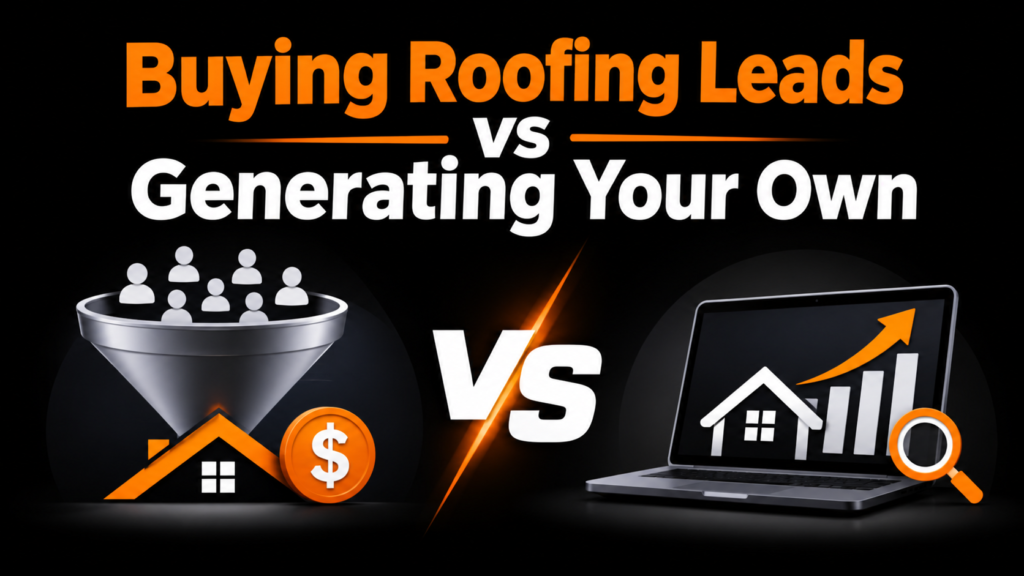
Roofing companies need a steady flow of qualified homeowners to keep their sales teams busy and their schedules full. When new projects slow down, buying leads can seem like the fastest way to bring in more business. You pay a lead provider, receive homeowner inquiries, and start making calls.
But there is another option: generate your own roofing leads through your website, local SEO, paid advertising, referrals, and other marketing channels.
Both approaches can help a roofing business grow. However, they work differently. Buying leads can provide faster access to potential customers, while generating your own leads gives you more control over the customer journey, marketing data, and long-term growth.
So, should you continue paying for shared roofing leads, switch to exclusive leads, or build your own lead generation system?
Let’s compare the options, their advantages, disadvantages, and long-term value.
What Does It Mean to Buy Roofing Leads?
When you buy roofing leads, you pay a third-party provider to send you contact information from homeowners who may need roofing services.
These inquiries may come from online forms, advertising campaigns, comparison websites, or other lead-generation sources.
Depending on the agreement, you may receive leads that are also sent to other roofing contractors or leads reserved for your business.
What Are Shared Roofing Leads?
Shared roofing leads are homeowner inquiries sold to multiple roofing contractors. For example, a homeowner submits a form requesting a roof replacement estimate. The provider may send that inquiry to three or four contractors in the same service area.
Each contractor receives the same opportunity and competes to contact the homeowner first.
Advantages of shared leads:
-
They may have a lower upfront cost than exclusive leads.
-
You can receive inquiries without building a complete marketing system.
-
They can help fill gaps when your existing pipeline is slow.
-
You can test new service areas without making a major marketing investment.
Disadvantages of shared leads:
-
You compete with other contractors for the same homeowner.
-
The homeowner may receive several calls within a short period.
-
Price competition can make closing profitable projects harder.
-
Some inquiries may already be contacted by competitors before your team responds.
Shared leads can be useful when you have a limited budget and a strong follow-up process. However, relying on them too heavily can make consistent sales growth difficult.
What Are Exclusive Roofing Leads?
Exclusive roofing leads are inquiries sold or assigned to one roofing contractor rather than distributed among several competing businesses.
For example, a homeowner requests a roof inspection through a campaign created specifically for your company. The inquiry is assigned to your sales team instead of being shared with other contractors.
Advantages of exclusive leads:
-
You have less direct competition for the same inquiry.
-
Your sales team can focus on building a relationship with the homeowner.
-
You have more time to understand the customer’s needs.
-
You may have a better opportunity to control the sales conversation.
Disadvantages of exclusive leads:
-
They generally require a higher upfront investment.
-
Exclusivity does not guarantee that the homeowner is ready to buy.
-
Poor targeting can still produce unqualified inquiries.
-
You remain dependent on the provider’s pricing and lead supply.
Exclusive leads can offer a better sales opportunity, but you should evaluate their actual conversion performance rather than assuming they will automatically produce more revenue.
What Does It Mean to Generate Your Own Roofing Leads?
Generating your own leads means attracting homeowners through marketing channels that your business controls or manages.
Instead of purchasing contact information from another provider, you build systems that encourage potential customers to contact your roofing company directly.
These systems can include:
1. Local SEO and Google Business Profile
Local SEO helps your roofing company appear when homeowners search for services in your area.
For example, someone searching for a roof replacement contractor in your city may discover your website through organic search results.
A strong local SEO strategy includes:
-
Optimized service pages for your target locations.
-
Accurate business information and contact details.
-
Helpful roofing articles that answer homeowner questions.
-
Customer reviews and consistent review management.
-
A properly maintained Google Business Profile.
-
Clear calls to action on important website pages.
Local SEO takes time, but it can become a valuable source of ongoing inquiries.
2. A Roofing Website Built to Convert
Your website should do more than explain what your company offers. It should make it easy for homeowners to request an estimate or schedule an inspection.
Important website elements include:
-
Clear roofing service descriptions.
-
Professional project photos.
-
Customer testimonials.
-
Service area information.
-
Easy-to-use contact forms.
-
Visible phone numbers.
-
Strong estimate request buttons.
A website that attracts visitors but fails to convert them into inquiries wastes valuable marketing opportunities.
3. Paid Advertising
Paid advertising can help roofing companies reach homeowners who are actively looking for roofing services.
Search advertising can target people searching for terms related to roof replacement, roofing contractors, and roof inspections.
Social media advertising can also introduce your services to homeowners in selected locations.
The main advantage is that you can control targeting, budgets, messaging, and campaign adjustments. However, advertising costs continue as long as you want to maintain traffic through paid campaigns.
4. Content Marketing
Roofing content helps homeowners understand their options before contacting a contractor.
You can publish articles about roof replacement costs, roofing materials, storm damage assessments, maintenance, and choosing a roofing contractor.
Useful content builds trust and gives search engines more relevant information about your services.
It can also support other marketing channels by giving your sales team helpful resources to share with potential customers.
Buying Roofing Leads vs Generating Your Own: Key Differences
Both methods can bring new opportunities to your business, but they differ in speed, control, ownership, and long-term value.
| Factor | Buying Roofing Leads | Generating Your Own Leads |
|---|---|---|
| Speed | Often provides faster access to inquiries | Usually takes time to build |
| Initial investment | Pay for individual leads or packages | Invest in marketing, content, and campaigns |
| Competition | Shared leads create direct competition | Direct competition for the same inquiry may be lower |
| Lead ownership | Depends on provider agreements | Greater control over your own inquiry data |
| Lead quality | Depends on provider targeting and verification | Depends on your marketing and qualification process |
| Scalability | Depends on provider inventory and pricing | Can expand through multiple marketing channels |
| Long-term value | Requires continued purchasing | Can build lasting marketing assets |
Neither approach is automatically better for every roofing company. Your decision should depend on your sales capacity, marketing budget, current lead sources, and business goals.
Which Option Provides Better Roofing Lead Quality?
The number of leads you receive does not tell you how many roofing projects you will sell.
A company receiving 100 low-quality inquiries may generate less revenue than a company receiving 20 well-qualified opportunities.
This is why roofing lead quality should be a major part of your decision.
Factors That Affect Purchased Lead Quality
When evaluating roofing lead companies, consider the following:
-
Location accuracy: Does the homeowner live within your service area?
-
Service intent: Is the homeowner looking for a service you actually provide?
-
Contact accuracy: Is the phone number or email address valid?
-
Buying intent: Is the homeowner actively considering a roofing project?
-
Lead freshness: How long ago did the homeowner submit the inquiry?
-
Qualification: Does the provider collect enough information to help your team evaluate the opportunity?
Ask providers how they collect, verify, distribute, and replace leads before purchasing a package.
Factors That Affect Self-Generated Lead Quality
When you generate your own leads, you have more opportunities to shape who contacts your business.
You can create campaigns around specific roofing services, target selected locations, and use forms that collect useful project information.
For example, your form could ask:
-
What roofing service do you need?
-
Where is your property located?
-
Are you planning a roof replacement?
-
When would you like the project completed?
These questions help your team understand the inquiry before making a sales call.
However, generating your own leads does not guarantee high quality. Poor targeting, unclear website messaging, and ineffective advertising can attract the wrong audience.
The Real Cost of Buying Leads vs Generating Your Own
At first, buying leads may appear more affordable because you only pay for the inquiries you receive.
However, the actual cost of acquiring a roofing customer depends on more than the price of an individual lead.
Consider this example:
A roofing company purchases 40 leads at $50 each. Its total lead investment is $2,000.
If the company closes four projects, its cost per acquired customer is $500.
Now imagine another company spends $3,000 on marketing and generates 60 inquiries. If it closes eight projects, its cost per acquired customer is $375.
Illustrative example only. These figures are not industry benchmarks or guaranteed results.
| Measurement | Purchased Leads | Self-Generated Leads |
|---|---|---|
| Marketing investment | $2,000 | $3,000 |
| Leads received | 40 | 60 |
| Projects closed | 4 | 8 |
| Cost per lead | $50 | $50 |
| Cost per customer | $500 | $375 |
The important lesson is that cheaper leads do not always produce cheaper customers.
You should compare the total marketing investment with the number of qualified opportunities, estimates, closed projects, and revenue generated.
For a deeper breakdown, connect this section to your article about the cost per lead for roofing companies.
Should You Stop Buying Shared Roofing Leads?
Not necessarily. Buying leads can still be useful, especially when your company needs inquiries quickly or is entering a new market.
The problem starts when purchased leads become your only source of new business.
If your sales pipeline depends entirely on a third-party provider, you have limited control over pricing, lead availability, competition, and distribution.
A better approach may be to use purchased leads while gradually building your own marketing system.
When Buying Roofing Leads Makes Sense
Consider purchasing leads when:
-
Your sales team has available capacity.
-
You need inquiries while your website and SEO strategy develop.
-
You want to test demand in a new service area.
-
You have enough budget to evaluate lead performance.
-
Your team can contact new inquiries quickly.
When Generating Your Own Leads Makes More Sense
Focus more heavily on your own lead generation when:
-
You want to reduce dependence on third-party providers.
-
You want greater control over marketing campaigns.
-
You want to build long-term website visibility.
-
You want to understand where your inquiries originate.
-
You want a repeatable system for attracting homeowners.
For many roofing companies, combining both approaches during a transition period is more practical than stopping purchased leads immediately.
How to Build a Roofing Lead Generation System You Control
Building your own lead generation system does not mean you need to stop using every third-party service. It means creating a reliable process that attracts, captures, tracks, and follows up with potential customers.
Here are five practical steps to get started.
Step 1: Define Your Ideal Roofing Customer
Identify the services and locations you want to target.
Decide whether you want more roof replacement projects, residential roofing inquiries, or opportunities in specific service areas.
Clear targeting helps your marketing reach homeowners who are more likely to need your services.
Step 2: Improve Your Online Visibility
Invest in local SEO, service pages, Google Business Profile optimization, and useful website content.
Focus on searches that indicate a homeowner is looking for a roofing contractor rather than targeting broad keywords that may attract unrelated visitors.
Step 3: Create a Lead Capture Process
Make it simple for homeowners to contact your business.
Use estimate request forms, clear phone numbers, and landing pages designed around specific roofing services.
Avoid asking for unnecessary information that could discourage potential customers from completing the form.
Step 4: Automate Lead Follow-Up
Speed and consistency matter when responding to new inquiries.
A CRM and marketing automation system can help your business:
-
Send immediate inquiry confirmations.
-
Assign new leads to the right salesperson.
-
Create follow-up reminders.
-
Track calls and customer interactions.
-
Identify leads that need additional attention.
-
Monitor opportunities from initial contact to closing.
This reduces the chance of losing opportunities because someone forgot to follow up.
Step 5: Track Results and Improve
Review your marketing performance regularly.
Measure how many inquiries become qualified leads, how many estimates are scheduled, and how many projects close.
Use this information to identify which channels bring the best opportunities.
You can explore Fixody’s roofer lead generation services to learn how a more structured approach can help roofing businesses attract and manage new opportunities.
How to Choose Between Roofing Lead Companies and Your Own Marketing
If you decide to buy roofing leads, do not choose a provider based only on its advertised price.
Compare different roofing lead companies using practical performance measurements.
Before signing an agreement, ask:
-
Are the leads shared or exclusive?
-
How many contractors receive each shared inquiry?
-
How quickly are new leads delivered?
-
What information is collected from homeowners?
-
How are invalid or duplicate leads handled?
-
Can you select specific roofing services and locations?
-
Can you track which leads turn into completed projects?
-
Are there minimum purchase requirements or long-term contracts?
Also, calculate your actual customer acquisition cost instead of relying only on the advertised cost per lead.
For your own marketing, evaluate the same business outcomes. A successful system should generate qualified opportunities at a cost that supports profitable growth.
The goal is not simply to find cheaper lead services for roofers. It is to build a process that produces customers consistently and gives you better control over your sales pipeline.
The Best Strategy: Combine Short-Term Leads With Long-Term Growth
For many roofing businesses, the best decision is not choosing between buying leads and generating their own. It is using both strategically.
Purchased leads can provide short-term opportunities while your own marketing channels develop.
For example, you could:
-
Use exclusive or carefully selected shared leads to maintain your current pipeline.
-
Improve your website and local search visibility.
-
Run targeted advertising campaigns.
-
Publish helpful roofing content.
-
Automate lead capture and follow-up.
-
Track the performance of every marketing channel.
Over time, you can increase investment in the channels that generate profitable customers and reduce dependence on sources that produce poor results.
This approach gives your business immediate opportunities while creating a stronger foundation for future growth.
Build a Roofing Lead Generation System With Fixody
Buying roofing leads can help fill your sales pipeline, but depending entirely on third-party providers can limit your control over customer acquisition.
A stronger marketing strategy focuses on attracting the right homeowners, capturing their information, responding quickly, and tracking which opportunities become actual projects.
Fixody helps businesses develop smarter lead generation and marketing systems through strategy, automation, and connected customer journeys.
Instead of focusing only on generating more inquiries, the goal is to build a process that helps your roofing company attract, manage, and convert better opportunities.
Want to find out where your roofing business is losing potential leads?
Book a free 15-minute call with Fixody. We can discuss your current lead generation process, identify opportunities for improvement, and help you understand what a stronger system could look like.
Frequently Asked Questions
Is It Better to Buy Roofing Leads or Generate Your Own?
Buying roofing leads can provide faster access to homeowner inquiries, while generating your own leads gives you greater control over marketing, targeting, and customer data. Many roofing companies benefit from combining both approaches.
Are Shared Roofing Leads Worth Buying?
Shared roofing leads can be worthwhile when they are affordable, relevant, and properly qualified. However, you must compete with other contractors contacting the same homeowner. Evaluate their performance based on closed projects rather than lead volume alone.
What Is the Difference Between Shared and Exclusive Roofing Leads?
Shared roofing leads are distributed to multiple contractors, while exclusive roofing leads are assigned to one contractor. Exclusive leads generally involve less direct competition, but they do not guarantee a sale or a higher conversion rate.
How Can I Check Roofing Lead Quality?
Check whether the homeowner’s contact information is accurate, the inquiry is recent, the property is within your service area, and the requested service matches your business. Also, track how many inquiries turn into estimates and completed projects.
How Much Should a Roofing Company Spend on Lead Generation?
There is no universal marketing budget for every roofing company. Your spending should depend on your revenue goals, average project value, profit margins, service area, and customer acquisition costs. Start with a measurable budget and adjust it based on actual results.
Can I Stop Buying Roofing Leads Completely?
Yes, but it is usually better to build alternative lead sources before stopping purchased leads. Develop your website, local SEO, advertising, and follow-up systems first. Once these channels generate consistent opportunities, you can reduce your dependence on third-party providers.
How Long Does It Take to Generate Roofing Leads Through SEO?
SEO timelines vary based on competition, website quality, location, and the work required. Some improvements may produce results sooner, while building strong organic visibility often takes several months or longer. It should be treated as a long-term marketing investment.
Do Exclusive Roofing Leads Guarantee More Sales?
No. Exclusive leads reduce direct competition for an inquiry, but the homeowner may still be comparing contractors, researching prices, or delaying the project. Sales results depend on lead quality, timing, pricing, trust, and follow-up.