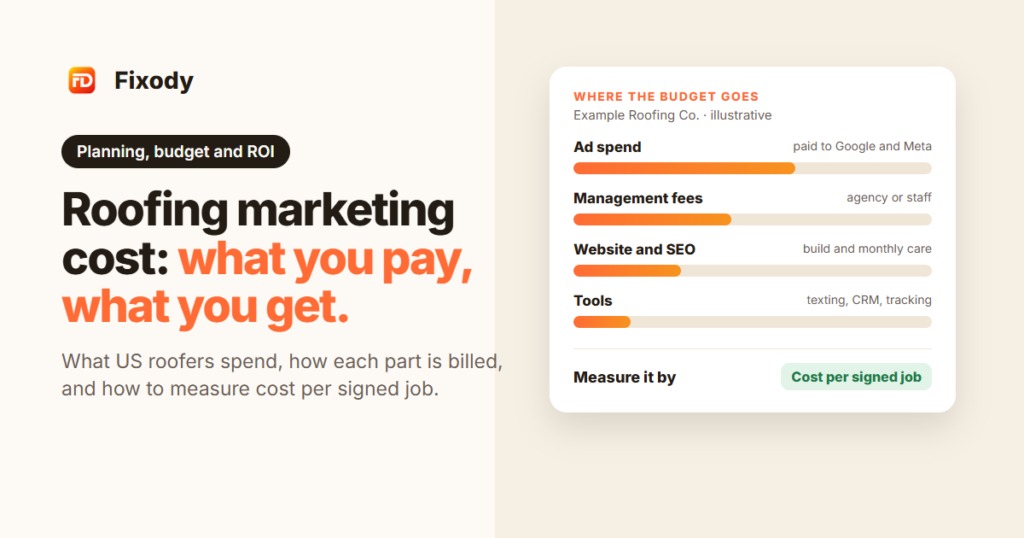
Roofing marketing cost is everything a roofing company pays to win new jobs: ad spend paid to Google or Meta, fees for an agency or staff to run the work, a website, SEO, and the software that answers, tracks and follows up on leads. There is no single price. Most US roofers set a budget as a share of revenue and adjust it by season, market and growth goals. This guide breaks down what roofers usually spend, what each part costs and how it is billed, what tends to be extra, and how to tell whether the money is working.
Key takeaways
- Most small businesses plan marketing as a percentage of revenue. The right share depends on how much work comes from referrals and how fast you want to grow.
- Your total cost has three layers: ad spend paid to the platforms, fees for the people who run it, and tools and software.
- Ad spend is usually billed separately from agency fees. Always ask what a quoted price includes.
- Judge marketing by cost per booked inspection and cost per signed job, not by clicks or leads alone.
- A cheaper package that leaves calls unanswered and estimates without follow-up often costs more per job than a fuller one.
In this guide
- How much roofing companies spend on marketing
- What each part costs and how it is billed
- What is usually extra
- Agency, in-house or freelancers
- Cost by company size: our four programs
- How to tell what you get for the money
- Frequently asked questions
How much do roofing companies spend on marketing?
Most roofers set a marketing budget as a share of revenue. The US Small Business Administration notes that many businesses use a percentage of revenues as a guide, and that the right percentage varies widely. The survey it cites put average marketing spend at 7.9% of revenue in 2018, with consumer service businesses spending more than average.
For a roofing company, where you land in that range depends on three things:
- How much work comes from referrals. A roofer with a strong referral base and repeat builders can spend a smaller share.
- How fast you want to grow. Adding crews, entering a new town or moving into replacements usually needs a bigger share for a while.
- Your market. Busy metro areas with many competitors cost more to win than small towns.
Here is what different shares of revenue look like in dollars. These are simple calculations to help you plan, not recommendations or industry averages:
| Annual revenue | At 3% of revenue | At 5% of revenue | At 8% of revenue |
|---|---|---|---|
| $750,000 | $22,500 a year (about $1,900 a month) | $37,500 a year (about $3,100 a month) | $60,000 a year ($5,000 a month) |
| $2 million | $60,000 a year ($5,000 a month) | $100,000 a year (about $8,300 a month) | $160,000 a year (about $13,300 a month) |
| $5 million | $150,000 a year ($12,500 a month) | $250,000 a year (about $20,800 a month) | $400,000 a year (about $33,300 a month) |
| $12 million | $360,000 a year ($30,000 a month) | $600,000 a year ($50,000 a month) | $960,000 a year ($80,000 a month) |
That total covers everything: ad spend, fees, website, software and any marketing staff. Many roofers also spend unevenly through the year, with more in spring and after storms and less in the slow winter months.
What does each part of roofing marketing cost?
Prices vary too much by market and provider to quote fairly, but the way each part is billed is fairly standard. Knowing this helps you compare quotes like for like:
| Part | How it is usually billed | What drives the cost |
|---|---|---|
| Roofing website | One-time build, then a monthly fee for hosting and care | Number of pages, service-area pages, custom design, copywriting and photos |
| Local SEO | Monthly fee | Number of towns and services you target and how competitive they are |
| Google Business Profile | Monthly fee, often bundled with SEO | Number of locations, posting frequency, review replies |
| Google Local Services Ads | You pay Google per lead, not per click | Location, job type, lead type and your bidding settings |
| Google Ads and Meta ads | Ad spend paid to the platform, plus a management fee | Your budget, number of campaigns and markets, how much testing is done |
| Missed-call text-back and AI answering | Setup plus a monthly fee | Call volume, hours covered, whether it books onto your calendar |
| Reviews and estimate follow-up | Setup plus a monthly fee | Number of sequences, texts and emails sent, CRM connections |
| Call tracking and reporting | Monthly fee, often per tracking number | Number of numbers, channels and locations you report on |
Local Services Ads are worth a note. Google says you are charged for valid leads, that lead prices depend on your location, the job type, the lead type and your bidding settings, and that leads judged invalid or low quality are not charged. That makes the cost easier to tie to real enquiries than click-based ads, but you still need to answer those leads fast for them to pay off.
What is usually extra in a roofing marketing quote?
Two quotes with the same monthly number can cover very different work. Before you compare, ask whether each of these is included:
- Ad spend. Most agency fees do not include the money paid to Google or Meta. A quote of a few thousand dollars a month may be the fee only.
- Software and tools. CRM, texting, call tracking and review software may be billed by the agency, by the vendor directly or not included at all.
- Setup fees. Websites, ad accounts and automations often carry a one-time setup cost.
- Photos and video. Real job photos make ads and websites work better. Someone has to take them.
- Contract length and exit terms. Check the minimum term, the notice period and who owns the website, ad accounts and data if you leave.
- Exclusivity. Ask whether the agency also markets other roofers in your service area.
Should a roofer use an agency, hire in-house or use freelancers?
The cost depends as much on who runs the work as on the work itself. Each option has a place:
| Option | Works well when | Watch out for |
|---|---|---|
| Marketing agency | You want one team to run the whole system, with reporting tied to booked jobs | Fees that exclude ad spend and tools; agencies that serve several roofers in your area |
| In-house marketer | You are large enough to keep one person fully busy and can pay for their tools | One person rarely covers ads, SEO, websites and automation well; salary is fixed in slow months |
| Freelancers | You need one specific job done, such as a website rebuild | Nobody owns the whole picture, so calls, follow-up and tracking fall between the gaps |
| Do it yourself | You are just starting and have more time than budget | It competes with estimates, crews and cash flow for the owner’s time |
How does roofing marketing cost change with company size?
A one-crew roofer and a multi-location company need different things, so the cost scales with how much of the system you switch on and how many markets you cover. Our roofing marketing programs are built around that:
| Program | Typical stage | Main focus | Price |
|---|---|---|---|
| Launch | Under $1M a year, one or two crews | Google Business Profile, missed-call text-back, review requests, a quote-ready landing page | Quoted on a 15-minute call |
| Build | $1M to $3M a year | Adds local SEO, 24/7 answering, estimate follow-up, storm campaigns, Local Services Ads and a full website | Quoted on a 15-minute call |
| Scale | $3M to $10M a year | Adds SEO across every town you serve, calendar booking, old-lead reactivation and Google Ads | Quoted on a 15-minute call |
| Dominate | $10M+ a year, several markets | Every location covered, Meta ads, reporting by location and weekly check-ins | Quoted on a 15-minute call |
Revenue is a rough guide, not a rule. We quote on a short call because ad spend, the number of towns and the state of your website and Google profile change the price more than company size does. You can book a 15-minute call to get a quote for your market.
How do you know what you get for the money?
Track cost per booked inspection and cost per signed job. Clicks and leads are useful early signals, but they do not pay for crews. Here is an illustrative month for Example Roofing Co. It shows the method, not real results:
| Measure | Example month | How to work it out |
|---|---|---|
| Total marketing cost | $8,000 | Ad spend + fees + tools for the month |
| Leads | 50 | Calls, forms and messages from marketing |
| Cost per lead | $160 | $8,000 ÷ 50 |
| Inspections booked | 25 | Leads that turned into appointments |
| Cost per booked inspection | $320 | $8,000 ÷ 25 |
| Jobs signed | 8 | Inspections that turned into contracts |
| Cost per signed job | $1,000 | $8,000 ÷ 8 |
Compare cost per signed job with your average job value and margin, and the question of whether marketing is “worth it” gets a clear answer. It also shows where to fix things. If leads are high but inspections are low, the problem is response speed or follow-up, not the ads. Our reporting and tracking service sets up these numbers every month.
Frequently asked questions
How much does roofing marketing cost per month?
It depends on your revenue, market and goals. Many businesses plan marketing as a percentage of revenue, so a smaller roofer may spend a few thousand dollars a month and a multi-location company far more. Ask what each quote includes before comparing.
What percentage of revenue should a roofing company spend on marketing?
There is no fixed rule. The SBA notes that many businesses use a percentage of revenue as a guide and that the share varies widely. Roofers with strong referrals can spend less; those adding crews or entering new markets usually spend more for a while.
Does the agency fee include ad spend?
Usually not. Most agencies charge a fee for their work, and the money paid to Google or Meta is billed separately. Ask for both numbers so you know the full monthly cost.
How do Google Local Services Ads charge roofers?
You pay per lead, not per click. Google says lead prices depend on location, job type, lead type and your bidding settings, and that leads judged invalid or low quality are not charged.
Is a cheaper marketing package better for a small roofer?
Not always. A package that brings leads but leaves calls unanswered and estimates without follow-up can cost more per signed job than a fuller one. Compare on cost per signed job, not monthly price.
How long before roofing marketing pays off?
Paid ads and Local Services Ads can bring calls within weeks. SEO and Google profile work build over months. Missed-call text-back and estimate follow-up often help quickly because they recover leads you already have.
Why does Fixody quote prices on a call?
Because your market, the number of towns you serve, your ad budget and the state of your website and Google profile change the price. A 15-minute call lets us quote for your situation instead of a generic package.
Sources
- US Small Business Administration: How to Get the Most From Your Marketing Budget
- Google Local Services Help: How leads work
Know where your money leaks before you spend more
The free lead-leak report shows where you are losing jobs today: missed calls, slow replies, estimates with no follow-up, a thin Google profile or a website that does not convert. Want a quote instead? Book a 15-minute call.