Revenue growth is one of the biggest goals for any business. Companies want more customers, higher sales, and better returns from their marketing investments. However, the way businesses achieve these goals has changed. Traditional marketing still plays an important role, but many companies now use data, technology, and continuous experimentation to find faster and more sustainable ways to grow.
An effective Revenue Growth Strategy focuses on more than running advertisements or launching promotional campaigns. It looks at the entire customer journey, from attracting potential customers to converting them into buyers and encouraging repeat purchases.
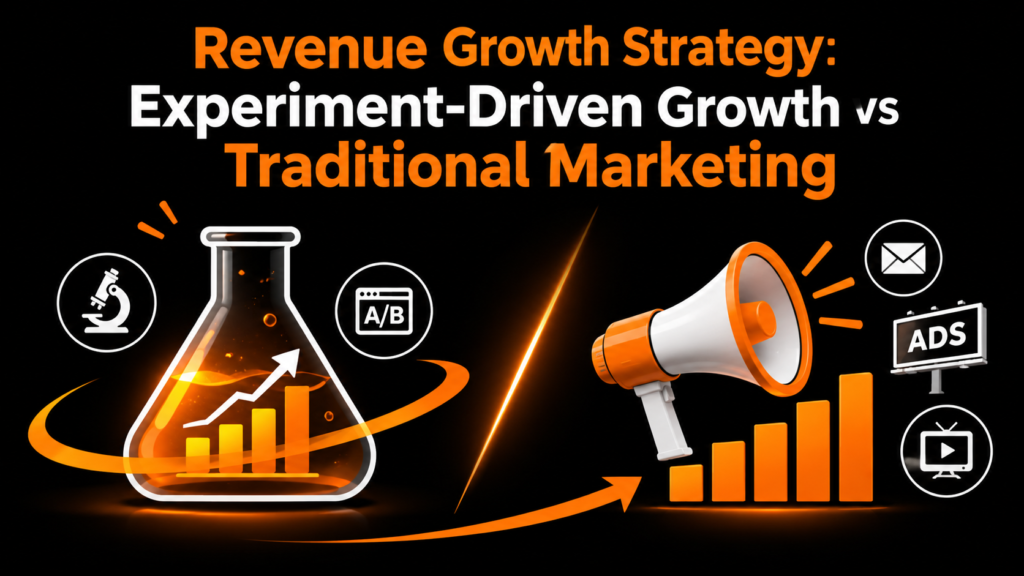
Two common approaches are experiment-driven growth and traditional campaign-based marketing. Both can help businesses increase revenue, but they work differently. Understanding their strengths, limitations, and best use cases can help companies choose the right approach for their goals.
What Is a Revenue Growth Strategy?
A Revenue Growth Strategy is a structured plan that helps a business increase its income through customer acquisition, conversion improvements, customer retention, and increased customer value.
Instead of focusing only on generating more leads, a strong strategy examines every stage of the buying process.
For example, a business might increase revenue by:
- Attracting more qualified website visitors.
- Improving landing page conversion rates.
- Reducing the number of abandoned shopping carts.
- Encouraging existing customers to purchase again.
- Increasing average order value.
- Improving customer retention.
- Identifying new markets and revenue opportunities.
The best approach depends on the company’s business model, target audience, available resources, and growth objectives.
A successful growth strategy also needs clear performance indicators. Revenue, customer acquisition cost (CAC), customer lifetime value (CLV), conversion rate, and retention rate help businesses understand whether their activities are producing meaningful results.
What Is Experiment-Driven Growth?
Experiment-driven growth is an approach that uses small, measurable tests to discover which marketing and business activities produce the best results.
Rather than making large investments based on assumptions, businesses test different ideas, analyze the results, and improve their strategies using real customer behavior.
This approach is closely connected to growth marketing strategy, where marketing teams continuously experiment across different parts of the customer journey.
How Experiment-Driven Growth Works
The process usually follows five steps:
1. Identify a growth opportunity
Start by finding an area where the business could improve. For example, a website might receive plenty of visitors but generate very few inquiries.
2. Develop a hypothesis
Create a reasonable explanation for how an improvement could produce better results.
Example: Changing the headline on a landing page to explain the main customer benefit will increase inquiry submissions.
3. Design an experiment
Decide what you want to test, which audience will participate, and which metric will measure success.
4. Measure the results
Compare the experiment’s performance against the original version. Use relevant data instead of relying on opinions.
5. Learn and improve
If the experiment succeeds, consider implementing the change more widely. If it fails, examine what happened and use the findings to develop another test.
The important point is that every experiment should produce useful information, even when the original idea does not work.
Examples of Experiment-Driven Growth
Businesses can test different ideas across their marketing and sales processes.
Some examples include:
- Testing two landing page headlines to identify which generates more leads.
- Comparing different email subject lines to improve open rates.
- Testing different pricing presentations to understand customer preferences.
- Changing checkout steps to reduce abandoned purchases.
- Testing personalized product recommendations to increase average order value.
- Comparing different calls to action to improve conversions.
These experiments help businesses make decisions based on evidence rather than assumptions.
What Is Traditional Campaign-Based Marketing?
Traditional campaign-based marketing focuses on planning and launching marketing activities around specific objectives, audiences, and time periods.
Businesses usually develop a campaign, allocate a budget, select marketing channels, and run promotional activities for a defined period.
Common examples include:
- Television and radio advertisements.
- Newspaper and magazine promotions.
- Seasonal marketing campaigns.
- Paid social media advertisements.
- Search engine advertising.
- Email marketing campaigns.
- Product launches and promotional events.
Traditional marketing is often organized around campaign schedules and predefined budgets.
For example, a retail business might launch a holiday promotion across social media, email, and paid advertising. The campaign runs for several weeks, and the marketing team evaluates its performance after completion.
This model can work well when businesses have clear promotional goals, established audiences, and predictable marketing schedules.
Growth Marketing vs Traditional Marketing: Key Differences
Understanding growth marketing vs traditional marketing helps businesses decide how to allocate their time, budget, and resources.
Both approaches aim to attract customers and generate revenue. However, their methods, measurement systems, and optimization processes are different.
1. Planning and Execution
Traditional marketing generally starts with a campaign plan. Teams decide what message to communicate, which channels to use, and when the campaign will run.
Experiment-driven growth starts by identifying an opportunity. Instead of committing to one large campaign, teams test different approaches and adjust their activities based on performance.
2. Budget Allocation
Traditional marketing often requires a predefined campaign budget.
Experiment-driven growth may begin with smaller investments. Teams can test different channels and ideas before committing more resources to successful activities.
This does not mean experiments are always inexpensive. It means spending decisions can be guided by evidence.
3. Performance Measurement
Traditional campaigns commonly measure impressions, reach, clicks, engagement, and conversions.
Experiment-driven growth looks at these metrics alongside broader business outcomes, including customer acquisition cost, customer lifetime value, retention, and revenue.
4. Optimization
Traditional campaigns may be evaluated after a scheduled period.
Experiment-driven growth uses continuous testing and improvement. Teams can adjust landing pages, messaging, offers, and customer experiences as new information becomes available.
5. Customer Journey
Traditional marketing often focuses heavily on attracting customers and generating awareness.
Growth marketing considers the complete customer journey, including acquisition, activation, retention, referral, and revenue.
| Comparison | Experiment-Driven Growth | Traditional Marketing |
|---|---|---|
| Main approach | Continuous experiments | Planned campaigns |
| Planning | Flexible and iterative | Structured and scheduled |
| Budget | Tested and adjusted | Often predefined |
| Measurement | Business outcomes and experiments | Campaign performance |
| Optimization | Continuous | Usually campaign-based |
| Customer focus | Entire customer journey | Often awareness and acquisition |
| Best suited for | Continuous improvement | Planned promotions and brand awareness |
Neither approach is automatically better. The right choice depends on the business objective and the situation.
Understanding Growth Loops and Their Role in Revenue Growth
Growth loops are repeatable processes where one customer interaction helps generate another growth opportunity.
Unlike a traditional campaign that may stop when the advertising budget ends, a growth loop can continue creating value through customer behavior.
For example, consider a software company that encourages existing customers to invite colleagues.
The process works like this:
- A customer signs up for the software.
- The customer invites team members.
- New users join through those invitations.
- Some invited users become paying customers.
- New customers invite additional colleagues.
This creates a cycle where existing customer activity contributes to future customer acquisition.
Common Types of Growth Loops
Referral loops: Existing customers recommend a product or service to other people.
Content loops: Useful content attracts visitors who share it or create additional engagement.
Product-led loops: Customers experience product value and encourage others to use the same product.
User-generated content loops: Customers create reviews, testimonials, or other content that attracts new prospects.
Growth loops can become valuable business growth solutions because they help companies create repeatable acquisition opportunities instead of depending entirely on paid campaigns.
However, loops do not automatically generate growth. Businesses need a valuable product, a positive customer experience, and a clear reason for customers to participate.
When Should Businesses Use Experiment-Driven Growth?
Experiment-driven growth is particularly useful when businesses need to improve performance across multiple channels or understand why customers are not converting.
Consider using this approach when:
- Your website receives traffic but generates few leads.
- Customer acquisition costs are increasing.
- Your marketing team is unsure which channels perform best.
- You want to improve customer retention.
- Your existing campaigns are producing inconsistent results.
- You are launching a new product or entering a new market.
- You want to improve sales without constantly increasing advertising budgets.
For example, an online store might discover that many visitors add products to their carts but leave before completing checkout.
Instead of immediately spending more money on advertising, the business can test simplified checkout forms, different payment options, and clearer shipping information.
These experiments may improve conversions without requiring additional website traffic.
When Does Traditional Marketing Make More Sense?
Traditional campaign-based marketing remains useful in situations where businesses need predictable messaging, broad exposure, or coordinated promotional activities.
It can be especially effective when:
- Launching a new product or service.
- Promoting a seasonal offer.
- Building brand awareness in a new market.
- Supporting a major company announcement.
- Reaching audiences through established advertising channels.
- Coordinating promotions across multiple marketing platforms.
For example, a company introducing a new product may need a coordinated campaign involving social media, email marketing, public relations, and paid advertising.
A planned campaign ensures consistent messaging and helps the company reach its audience within a specific period.
How to Build an Experiment-Driven Growth Strategy
Businesses do not need complicated systems to start experimenting. A simple framework can help marketing teams organize their ideas and measure results.
Step 1: Define a Clear Revenue Goal
Start with a specific business objective.
For example, instead of saying you want more sales, define a goal such as increasing monthly online purchases by 15% over the next three months.
Step 2: Analyze Existing Performance
Review current marketing and sales data to identify weaknesses.
Look at website traffic, conversion rates, customer acquisition costs, lead quality, and customer retention.
Step 3: Prioritize Experiments
Not every idea deserves immediate attention.
Prioritize experiments based on potential impact, confidence in the hypothesis, and implementation effort.
Step 4: Track Every Experiment
Use a consistent tracking template to record what you are testing, why you are testing it, and what happened.
Step 5: Apply Successful Findings
Implement changes that produce reliable improvements. Continue testing new opportunities rather than treating one successful experiment as the final solution.
Simple Experiment-Tracking Template
A structured tracking sheet makes experimentation easier to manage. Businesses can use a spreadsheet or project management tool to record their tests.
| Tracking Field | Example |
|---|---|
| Experiment Name | Landing Page Headline Test |
| Growth Objective | Increase lead submissions |
| Hypothesis | A benefit-focused headline will generate more inquiries |
| Target Audience | New website visitors |
| Test Variation | Headline A vs. Headline B |
| Primary Metric | Landing page conversion rate |
| Baseline | 3% conversion rate |
| Test Duration | 3 weeks |
| Result | 3.8% conversion rate |
| Decision | Review statistical confidence before implementation |
| Next Step | Run a follow-up experiment |
The template should also include the experiment owner, start date, end date, and any important observations.
Important: Avoid making decisions based on a very small sample size. Make sure the test runs long enough to collect meaningful data and account for factors such as traffic changes and seasonal demand.
Can Businesses Combine Both Growth Approaches?
Yes. In many situations, combining experiment-driven growth with traditional marketing creates a more balanced approach.
Traditional campaigns can help businesses build awareness, launch products, and reach larger audiences. Experiment-driven methods can improve the performance of those campaigns and identify opportunities across the customer journey.
For example, a company might launch a paid advertising campaign to promote a new service.
At the same time, its marketing team can:
- Test different advertising messages.
- Compare landing page layouts.
- Analyze lead quality.
- Test different consultation offers.
- Improve follow-up email sequences.
- Measure which channels generate the highest-value customers.
This combination allows businesses to maintain a consistent marketing presence while continuously improving performance.
The strongest growth strategy is not necessarily about choosing one model over the other. It is about understanding when to use each approach and how they can support the same revenue objectives.
How Fixody Can Help Businesses Build Sustainable Growth
Developing a successful growth strategy requires more than choosing marketing channels. Businesses need to understand customer behavior, identify opportunities, and build systems that support continuous improvement.
Fixody helps businesses connect marketing strategy, automation, and growth-focused execution.
Through AI-powered marketing automation, CRM workflows, lead generation, and growth strategy development, businesses can improve how they attract prospects, manage leads, and convert opportunities into customers.
Whether a company needs better lead management, more effective marketing processes, or a structured growth plan, the right combination of strategy and technology can create a stronger foundation for long-term performance.
Explore Fixody’s marketing and growth solutions to identify opportunities for improving your business.
Frequently Asked Questions
What is the best revenue growth strategy for a small business?
The best approach depends on the business model, budget, and customer base. Small businesses can start by improving conversion rates, strengthening customer retention, testing marketing channels, and tracking customer acquisition costs.
What is the difference between growth marketing and traditional marketing?
Traditional marketing generally focuses on planned campaigns, brand awareness, and customer acquisition. Growth marketing uses continuous experimentation and data analysis across the entire customer journey to improve acquisition, retention, and revenue.
How do growth loops increase business revenue?
Growth loops create repeatable processes where existing customers, content, or product interactions help attract new customers. Referral programs and product-led invitations are common examples.
How often should businesses run growth experiments?
Businesses can run experiments continuously, depending on available resources and traffic. However, each test needs enough time and data to produce meaningful results before a decision is made.
Which metrics should businesses track for revenue growth?
Important metrics include revenue growth rate, customer acquisition cost, customer lifetime value, conversion rate, average order value, customer retention, and return on marketing investment.
Can traditional marketing and experiment-driven growth work together?
Yes. Traditional campaigns can generate awareness and attract customers, while experiments help improve messaging, conversion rates, customer experiences, and campaign performance.
Are growth experiments suitable for businesses with small budgets?
Yes. Small businesses can begin with low-cost experiments, such as testing website headlines, email subject lines, calls to action, and landing page layouts. The important part is choosing measurable objectives and learning from the results.