
October 27, 2026 · admin
Marketing Automation System: How to Choose and Connect the Right Tech Stack
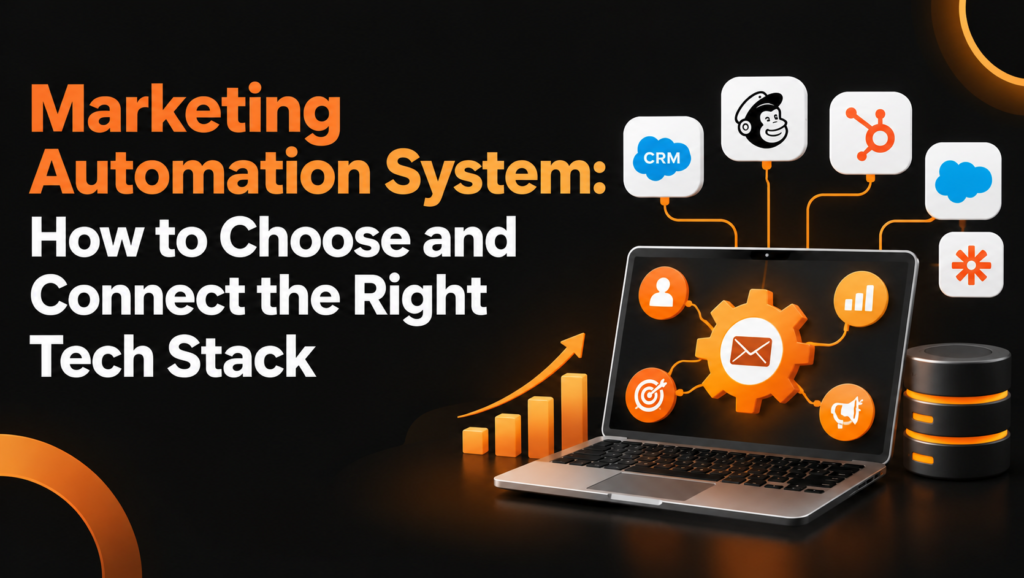
A marketing automation system helps businesses connect their marketing activities, customer data, and communication channels in one organized workflow. Instead of managing email campaigns, lead information, customer journeys, and performance reports separately, businesses can use connected technology to automate repetitive tasks and make better marketing decisions.
However, choosing the right system involves more than comparing software features. The best setup depends on how a business captures leads, manages customer relationships, delivers campaigns, measures results, and uses data to personalize communication.
A well-designed marketing tech stack connects these activities so information flows between tools without unnecessary manual work. This guide explains the essential layers of a marketing automation system, how to evaluate available solutions, and how to build a stack that supports long-term growth.
What Is a Marketing Automation System?
A marketing automation system is a combination of software, customer data, integrations, and workflows that helps businesses plan, execute, and measure marketing activities automatically.
Depending on the business, it may include a customer relationship management (CRM) platform, email marketing software, automation tools, analytics systems, customer data infrastructure, and artificial intelligence capabilities.
For example, when someone submits a form on a website, an integrated system can create a contact record, assign the lead to a sales representative, send a relevant follow-up email, and track subsequent engagement.
Without connected systems, employees may need to transfer information between platforms manually. A properly configured marketing automation system reduces this work and helps ensure that each team has access to consistent customer information.
Marketing Automation System vs. Marketing Automation Platform
A marketing automation platform is usually an individual software product that provides capabilities such as email campaigns, lead nurturing, segmentation, or workflow automation.
A marketing automation system is broader. It describes how that platform works alongside the CRM, analytics, customer data, and other tools used by the business.
A platform may provide the core automation engine, but the surrounding integrations determine how effectively the overall system supports marketing and sales operations.
The Six Layers of a Marketing Automation Tech Stack
A reliable marketing tech stack should be built around the functions a business needs rather than the number of tools it can purchase. Six layers provide a useful framework for evaluating the available options.
1. CRM: Customer Relationship Management
The CRM stores customer and prospect information, including contact details, lead status, sales activity, and previous interactions.
It also helps marketing and sales teams coordinate their work. For example, a marketing team can identify qualified leads while sales representatives can review engagement history before contacting prospects.
When selecting a CRM, consider:
- Contact and account management capabilities.
- Lead assignment and pipeline tracking.
- Integration with email and automation software.
- Data synchronization and duplicate management.
- Reporting and access controls.
The CRM should serve as a clearly defined source of truth for the customer and sales information it owns.
2. Email and Communication Tools
Email marketing tools help businesses send newsletters, promotional campaigns, onboarding messages, and automated follow-ups.
Depending on the customer journey, the communication layer may also include SMS, website forms, chat, or other messaging channels.
Choose tools that support audience segmentation, personalization, consent management, deliverability monitoring, and campaign reporting.
The goal is to deliver relevant communication based on customer behavior and preferences rather than sending the same message to every contact.
3. Marketing Automation Engine
The automation layer connects customer actions to predefined workflows.
For example, a prospect who downloads a resource may enter a nurturing sequence. If that person requests a consultation, the system can update their status, notify the sales team, and stop unrelated promotional messages where appropriate.
Look for workflow builders, conditional logic, event-based triggers, lead scoring, integration support, error handling, and workflow monitoring.
These capabilities allow teams to create consistent processes without manually managing every interaction.
4. Analytics and Reporting
Analytics tools help marketers understand whether campaigns and workflows produce meaningful results.
Useful measurements include lead conversion rates, email engagement, customer acquisition cost, pipeline contribution, and campaign-attributed revenue.
The analytics layer should connect marketing activity with business outcomes whenever reliable data is available.
Before selecting a reporting tool, establish which metrics matter, how they will be defined, and where the underlying data will come from. Otherwise, different platforms may report conflicting results.
5. Customer Data and Integration Layer
The data layer moves information between systems and helps maintain consistent customer records.
It may include native integrations, APIs, integration platforms, data warehouses, or customer data platforms. Not every business needs all these components.
A smaller company may operate effectively with native integrations and a carefully managed CRM. A larger organization with multiple brands, channels, and customer databases may require more advanced data infrastructure.
Prioritize accurate identity matching, reliable synchronization, clear ownership of important fields, and appropriate access controls.
6. AI-Powered Marketing Automation
AI can extend traditional automation by helping teams analyze customer behavior, classify leads, generate content variations, identify patterns, and personalize campaigns.
For example, an AI-assisted workflow may help prioritize leads using engagement and qualification data. A human reviewer can then verify the recommendation before it affects an important sales decision.
AI capabilities should be introduced where they solve a defined problem. They should not replace reliable data, clear business rules, or human oversight.
Businesses exploring these capabilities can learn more about Fixody’s AI-powered marketing automation services.
How to Choose the Right Marketing Automation System
Selecting a system becomes easier when the decision follows a consistent framework.
Step 1: Define Your Marketing Goals
Start by identifying the problems the technology needs to solve.
A business focused on lead generation may prioritize form capture, lead scoring, and nurturing. A subscription business may need onboarding sequences, retention campaigns, and customer lifecycle reporting.
Write down the intended outcomes before comparing software products.
Examples include reducing manual follow-up, improving lead-to-customer conversion, increasing campaign efficiency, or gaining clearer visibility into marketing performance.
Step 2: Map Your Existing Marketing Tech Stack
List every tool currently used for customer acquisition, communication, automation, reporting, and data management.
For each tool, document its purpose, owner, cost, important integrations, and the information it stores.
This inventory often reveals duplicated functionality, disconnected records, unused subscriptions, and manual processes that could be simplified.
Do not replace a working tool simply because a newer product offers more features. First determine whether the existing setup can meet the business requirement through configuration or integration.
Step 3: Compare Marketing Automation Solutions
Evaluate each potential solution against the same criteria.
| Evaluation area | What to check |
|---|---|
| Core features | Does it support the workflows you actually need? |
| Integrations | Can it connect reliably to your CRM and other essential tools? |
| Usability | Can the team manage workflows without excessive technical support? |
| Scalability | Can it handle expected growth in contacts, campaigns, and complexity? |
| Data management | Does it support accurate synchronization, access controls, and data exports? |
| Reporting | Can it measure meaningful campaign and business outcomes? |
| Total cost | What will software, implementation, maintenance, and training cost? |
A solution should be selected based on how well it fits the business, not simply its popularity or the number of features listed on its pricing page.
Step 4: Assess the Total Cost of Ownership
The subscription price is only one part of the investment.
Implementation, migration, integration development, staff training, ongoing administration, and additional usage fees may increase the total cost.
Compare the expected cost with the value of time saved, operational improvements, and measurable business results.
A smaller stack with dependable integrations can be more effective than an expensive collection of tools that creates unnecessary complexity.
Step 5: Test a Real Workflow Before Committing
Run a pilot using a representative customer journey.
For example, test what happens when a prospect submits a form, enters the CRM, receives a follow-up message, meets a qualification condition, and gets assigned to sales.
Check whether records synchronize correctly, messages arrive as expected, consent preferences are respected, and reporting captures the important events.
A practical test often reveals limitations that are difficult to identify from product demonstrations alone.
Common Marketing Automation System Mistakes
Even capable marketing automation tools can underperform when the surrounding system is poorly designed.
Buying Too Many Tools
Multiple products may perform the same functions while increasing costs and maintenance requirements. Review the existing stack before adding another platform.
Ignoring Integration Quality
An integration that transfers only some fields or updates records inconsistently can create operational problems. Test important data flows, failure notifications, and synchronization behavior.
Automating Broken Processes
Automation can make an inefficient process run faster without making it more effective. Standardize the process first, then automate the appropriate steps.
Overlooking Data Quality and Privacy
Duplicate contacts, outdated information, unclear consent records, and excessive access permissions can undermine campaign performance and create compliance risks. Establish data ownership, retention rules, and appropriate safeguards.
Measuring Activity Instead of Outcomes
The number of emails sent or workflows launched does not prove that the system is working. Track relevant indicators such as qualified leads, conversion rates, campaign contribution, and time saved.
When Should You Upgrade Your Marketing Tech Stack?
A marketing automation system may need to evolve as the business grows. Warning signs include frequent manual data transfers, inconsistent customer records, limited reporting, recurring integration failures, and workflows that are difficult to maintain.
An upgrade may also be appropriate when the business introduces new communication channels, expands into new markets, or needs more sophisticated personalization.
However, a complete replacement is not always necessary. Improving existing integrations, cleaning customer data, simplifying workflows, or introducing one carefully selected tool may solve the problem.
The right decision depends on the source of the limitation and the expected benefits of changing the system.
Build a Marketing Automation System That Works Together
Choosing a marketing automation system is not just a software purchasing decision. It is an opportunity to create a connected process for collecting customer information, delivering relevant communication, measuring performance, and improving marketing operations.
Start with clear goals, assess your existing tech stack, identify integration gaps, and test essential workflows before committing to major changes. Add AI capabilities when they provide a practical benefit, and review the system regularly as your business evolves.
Ready to simplify your marketing tech stack? Explore Fixody’s AI-powered marketing automation services and book a stack review to identify integration gaps, reduce unnecessary complexity, and build a more connected marketing workflow.
Frequently Asked Questions
What is the best marketing automation system?
The best marketing automation system depends on business size, customer journey complexity, budget, integration requirements, and reporting needs. Businesses should compare solutions against their specific workflows instead of choosing solely by brand popularity.
What tools should a marketing tech stack include?
A typical marketing tech stack includes a CRM, email or communication software, an automation engine, analytics, and integrations. AI capabilities and more advanced customer data infrastructure can be added when they address clear business needs.
What is the difference between a CRM and a marketing automation platform?
A CRM primarily manages customer records, relationships, and sales activity. A marketing automation platform focuses on executing campaigns, nurturing leads, and automating marketing workflows. The two systems often exchange information to support a connected customer journey.
Can AI improve a marketing automation system?
AI can support personalization, lead prioritization, content assistance, segmentation, and pattern analysis. Its effectiveness depends on data quality, appropriate controls, and how well the capability fits the underlying marketing process.
How do you measure marketing automation success?
Measure outcomes such as qualified lead volume, conversion rates, customer acquisition cost, pipeline contribution, campaign performance, and time saved. Choose metrics that align with business goals and use consistent definitions across reporting systems.