
October 14, 2026 · admin
Marketing Automation Strategy in the AI Era: What Changes vs Traditional Automation
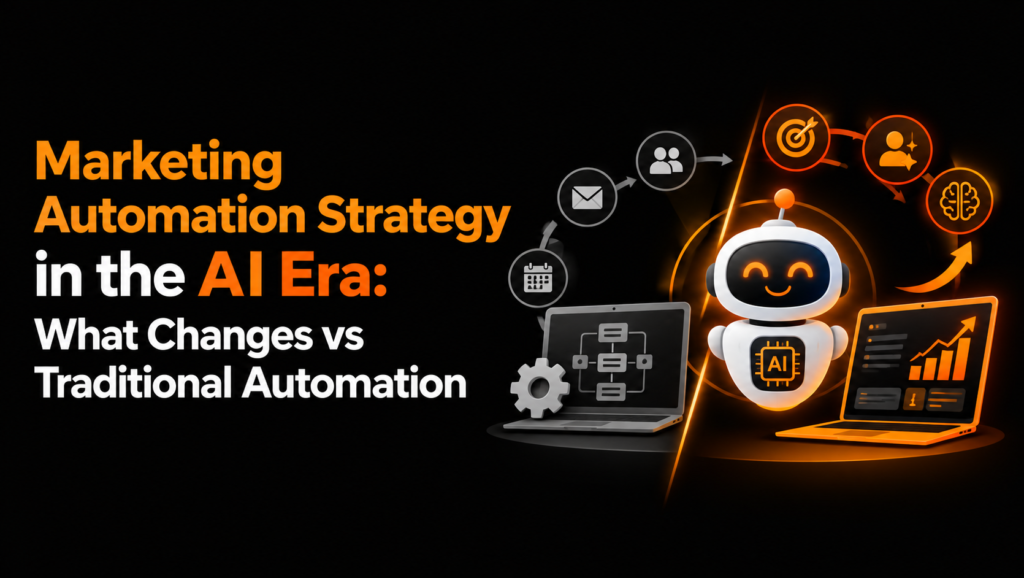
Marketing automation has evolved beyond scheduling emails and moving contacts through predefined workflows. Artificial intelligence (AI) now enables businesses to predict customer behavior, optimize message delivery, personalize content, and adjust marketing decisions using real-time signals.
However, this shift does not mean traditional automation is obsolete. Rule-based workflows remain reliable for repetitive processes, compliance requirements, lead routing, and clearly defined customer journeys. The strongest marketing systems combine predictable rules with AI-driven decisions where flexibility and prediction create measurable value.
A modern Marketing Automation Strategy should determine which tasks need consistency, which decisions benefit from prediction, and how both approaches work together. Rather than adding AI to every workflow, businesses should identify specific problems, select appropriate technologies, and measure whether automation improves customer experiences and business outcomes.
This guide explains the differences between traditional and AI-driven marketing automation, compares their strengths, and outlines a practical framework for building an effective strategy.
What Is Marketing Automation Strategy?
Marketing automation strategy is the plan for using technology, customer data, and automated processes to execute marketing activities efficiently and achieve measurable business objectives.
It covers how businesses capture leads, segment audiences, nurture prospects, personalize communications, coordinate campaigns, and measure performance.
A traditional strategy typically relies on predefined conditions. For example, when a visitor downloads a guide, the system adds the visitor to a segment and sends a follow-up email. Every action follows a workflow designed in advance.
An AI-driven strategy can go further by analyzing behavioral patterns, estimating customer intent, predicting conversion likelihood, and selecting an appropriate next action within defined limits.
A complete strategy addresses five core areas:
- Business objectives: Define whether automation should increase qualified leads, improve conversions, reduce acquisition costs, or strengthen retention.
- Customer data: Determine which first-party behavioral, transactional, and preference data can support relevant decisions.
- Workflow design: Map customer journeys and identify where fixed rules or adaptive decisions are appropriate.
- Technology and governance: Establish integrations, permissions, data quality standards, privacy safeguards, and human oversight.
- Performance measurement: Track outcomes that demonstrate business value rather than relying exclusively on email opens or workflow activity.
The goal is not maximum automation. It is to create a system that delivers the right experience with an appropriate balance of efficiency, relevance, and control.
Traditional vs. AI-Driven Marketing Automation
The primary difference between traditional and AI-driven marketing automation is how decisions are made.
Traditional automation executes conditions defined by marketers. AI-driven automation uses models to estimate outcomes, identify patterns, or recommend actions based on available data. Depending on the platform, those recommendations may be applied automatically or require human approval.
Traditional marketing automation: Rules and triggers
Traditional automation follows explicit instructions, often structured as if-then conditions.
For example:
- If a contact submits a form, send a confirmation email.
- If a lead visits the pricing page, notify the sales team.
- If a customer abandons a cart, send a reminder.
- If a subscription approaches renewal, trigger a renewal message.
These workflows are easy to understand, test, and audit. Their behavior is relatively predictable because the marketer defines the conditions and corresponding actions.
The main limitation is that fixed rules do not automatically adapt when customer behavior becomes more complex. A workflow might send the same reminder to every abandoned-cart customer even when some customers are likely to return without prompting and others need additional information.
Traditional automation is therefore most effective when processes are repeatable, conditions are clear, and consistency matters more than prediction.
AI-driven marketing automation: Prediction and adaptive decisions
AI-driven automation uses statistical models and machine learning to identify patterns in data and estimate what may happen next. Some platforms also use generative AI to produce or adapt marketing content.
Depending on the implementation, AI can help marketers:
- Predict which leads are more likely to convert.
- Estimate when individual contacts are most likely to engage.
- Identify customer segments based on behavior.
- Recommend products, content, or offers.
- Detect changes in engagement or purchase patterns.
- Select among approved campaign actions using performance signals.
For example, a traditional system might send a follow-up email two days after a prospect downloads a guide. An AI-enabled system could estimate conversion intent using engagement history, firmographic information, and other permitted signals, then recommend whether the prospect should receive educational content or a sales follow-up.
These predictions are not guarantees. Their quality depends on data coverage, model performance, appropriate testing, and the relevance of the chosen signals.
AI should improve decisions, not simply make workflows more complicated.
Marketing Automation Strategy: Traditional vs. AI Comparison
The following table summarizes the practical differences between both approaches.
| Area | Traditional automation | AI-driven automation |
|---|---|---|
| Decision logic | Predefined rules and conditions | Predictions, learned patterns, and recommendations |
| Segmentation | Manually defined audience groups | Predictive or behavior-based segments |
| Email timing | Fixed schedules or time delays | Predicted engagement windows |
| Lead scoring | Explicit point-based rules | Predictive conversion or qualification scores |
| Personalization | Templates and conditional content | Model-informed recommendations and adaptive content |
| Workflow changes | Marketer updates the logic | Models may adapt as new data becomes available |
| Explainability | Usually straightforward | Varies by model and platform |
| Data requirements | Often works with basic event data | Typically benefits from more relevant, reliable historical data |
| Governance | Rules and access controls | Rules plus model oversight, monitoring, and safeguards |
| Best use cases | Repetitive, predictable processes | Decisions involving uncertainty, patterns, and competing outcomes |
Neither approach is universally better. AI can improve decisions when useful data and a measurable prediction problem exist. Traditional automation can be the better choice when the process is straightforward or mistakes would be costly.
Four Ways AI Changes Marketing Automation
1. From static rules to predictive decisions
Traditional workflows respond to events that have already happened. AI introduces the ability to estimate likely future behavior.
A rule-based lead scoring system might assign points when a prospect opens an email, visits a product page, or downloads a resource. A predictive model can evaluate combinations of signals to estimate the probability of conversion.
This can help sales teams prioritize leads more effectively, provided the model is trained and evaluated against an appropriate business outcome.
For implementation, start with a specific prediction question, such as which leads are most likely to become qualified opportunities within a defined period. Compare model recommendations with the existing scoring process before using them to determine sales priorities.
Retain clear routing rules and human review for important decisions.
2. From fixed schedules to send-time optimization
Traditional campaigns often send emails at a predetermined time, such as 9 a.m. on a weekday. This approach is simple and can work well for announcements, scheduled launches, and time-sensitive communications.
Send-time optimization attempts to identify when individual recipients are more likely to engage. Depending on the platform, it may use historical engagement data, time-zone information, or broader behavioral patterns.
The potential benefit is improved engagement without requiring marketers to manually create dozens of schedules.
However, send-time optimization is not automatically valuable for every campaign. It may have limited impact when the audience is small, engagement data is sparse, or timing matters less than the offer and message itself.
Test optimized delivery against a suitable control group. Measure downstream outcomes, including qualified traffic, conversions, and revenue, rather than treating higher open rates as proof of success.
3. From static personalization to context-aware experiences
Traditional personalization often inserts a first name, company name, or previously selected product into a predefined template. It can also use rules to display different content to different segments.
AI can extend this approach by recommending content, products, or next steps based on combinations of customer behavior and relevant contextual signals.
For example, a software company could present different educational resources to visitors researching implementation, comparing pricing, or evaluating integrations.
The objective is to make each interaction more relevant without creating an entirely separate campaign for every customer.
AI-generated personalization should remain within approved brand, factual, privacy, and messaging boundaries. Businesses should also avoid using sensitive or unexpected inferences that could undermine customer trust.
For a deeper look at these techniques, internally link this section to Fixody’s related AI Personalization cluster article.
4. From fixed customer journeys to adaptive workflows
Traditional customer journeys usually follow a predetermined sequence. A prospect downloads a resource, receives an educational email, attends a webinar, and eventually receives a sales invitation.
AI can help determine which next step is most appropriate based on engagement, predicted intent, and prior interactions.
A highly engaged prospect might be offered a consultation, while someone who is still researching receives a relevant case study. The automation platform may recommend these actions or execute them under predefined constraints.
Adaptive workflows need guardrails. Without them, customers could receive excessive messages, move between inconsistent sequences, or experience unpredictable campaign behavior.
Set contact-frequency limits, suppression rules, approved actions, and escalation conditions. Use human review where financial, reputational, or customer-experience risks are significant.
Where Traditional Automation Still Wins
AI should not replace a dependable process simply because a newer technology is available.
Traditional rule-based automation remains a strong choice in several situations.
Operational consistency: Form confirmations, appointment reminders, subscription notifications, and standard onboarding steps benefit from deterministic behavior.
Simple lead routing: If a form field identifies a territory or product category, a rule can assign the lead directly to the correct sales team without requiring a predictive model.
Compliance-sensitive processes: Consent management, unsubscribe handling, suppression lists, and other mandatory controls should rely on explicit, testable rules and appropriate system safeguards. AI must not override these requirements.
Low-data environments: New businesses may not have sufficient historical information to support reliable predictions. A transparent rule-based workflow is often more practical until relevant data accumulates.
Straightforward decision problems: If a small number of conditions produces a satisfactory result, adding AI may increase cost, complexity, and maintenance without delivering meaningful improvements.
The guiding principle is simple: use rules for decisions that should be consistent, and consider AI for decisions that benefit from interpreting patterns or estimating uncertain outcomes.
How to Build a Modern Marketing Automation Strategy
A successful strategy begins with business needs, not a list of AI features.
Step 1: Define the outcome
Choose one measurable objective, such as increasing marketing-qualified leads, improving trial-to-paid conversion, or reducing the time sales teams spend qualifying prospects.
Establish a baseline before changing the workflow. This makes it easier to determine whether the new approach creates measurable improvement.
Step 2: Map the existing customer journey
Document the current triggers, segments, messages, handoffs, and decision points. Identify delays, repeated communications, abandoned journeys, and processes that depend on manual intervention.
Separate operational problems from prediction problems. A broken integration usually requires process or technical improvements, not an AI model.
Step 3: Audit your data
Check whether the required information is available, accurate, appropriately permissioned, and connected across relevant systems.
Review missing values, duplicate contacts, inconsistent campaign tracking, and gaps in conversion reporting. Poor-quality data can undermine both traditional workflows and AI predictions.
Step 4: Choose the right decision method
For every workflow decision, ask whether it needs a fixed rule, a predictive recommendation, or a combination of both.
For example, a predictive model might estimate lead conversion likelihood, while a deterministic rule routes the lead to the correct representative and enforces contact restrictions.
This hybrid design preserves control while allowing AI to support decisions where it has a meaningful advantage.
Step 5: Run a controlled pilot
Select one workflow with measurable outcomes and manageable risk. Compare the new approach with the existing process using a randomized control group where practical.
Define the primary metric in advance, allow sufficient time for results to mature, and check for unintended effects such as increased unsubscribe rates or lower-quality leads.
Step 6: Add governance and monitoring
Document what the model can recommend, which actions it can execute, and when human approval is required.
Monitor performance over time because customer behavior, data quality, and campaign conditions can change. Establish a fallback process so that essential workflows continue to operate if an AI component becomes unavailable or performs poorly.
Step 7: Scale based on evidence
Expand successful pilots only after reviewing their business impact, operational cost, and customer experience.
A workflow that improves engagement but fails to increase qualified conversions may not justify additional investment. Prioritize improvements that contribute to the objectives established at the beginning.
How to Measure Marketing Automation Performance in the AI Era
Modern measurement should connect automated activity to customer and business outcomes.
Useful metrics include:
- Lead-to-customer conversion rate: Measures how effectively leads become paying customers.
- Marketing-qualified lead rate: Shows whether campaigns generate prospects who meet defined qualification criteria.
- Revenue per campaign or customer segment: Helps evaluate commercial contribution.
- Time to conversion: Measures how quickly prospects progress toward a purchase.
- Customer acquisition cost: Helps determine whether automation improves acquisition efficiency.
- Engagement and unsubscribe rates: Reveal whether communications remain relevant and acceptable to recipients.
- Incremental lift: Estimates the additional impact of the automation compared with a suitable control group.
For AI-driven workflows, monitor model performance as well. Depending on the use case, this may include prediction accuracy, calibration, recommendation acceptance, or changes in conversion performance across customer segments.
Avoid attributing every improvement to AI. Seasonality, pricing changes, new creative, audience differences, and other campaign adjustments can influence results. Controlled experiments provide stronger evidence than before-and-after comparisons alone.
Common Marketing Automation Strategy Mistakes to Avoid
Automating a broken process: Fix inaccurate data, unclear ownership, and inefficient customer journeys before adding advanced capabilities.
Using AI without a defined objective: A predictive score or generated message is useful only when it supports a meaningful business decision.
Replacing every rule with a model: Maintain simple, deterministic workflows wherever they provide reliable results.
Ignoring customer privacy: Use appropriate consent, access controls, data minimization, retention practices, and applicable privacy requirements.
Measuring activity instead of impact: More automated emails or faster content production do not necessarily mean more revenue or better customer relationships.
Launching without oversight: Monitor outputs, provide escalation paths, and define fallback behavior for unexpected results.
Conclusion: Build a Hybrid Marketing Automation Strategy
The evolution of marketing automation is not a contest between traditional rules and artificial intelligence. It is an opportunity to combine the strengths of both.
Traditional automation provides consistency, transparency, and dependable execution. AI can support prediction, adaptive personalization, send-time optimization, and decisions that involve complex behavioral patterns.
An effective Marketing Automation Strategy identifies where each approach creates value, establishes measurable objectives, protects customer trust, and expands only when evidence supports the investment.
For businesses beginning this transition, the best first step is to improve one meaningful workflow, test whether AI offers a measurable advantage, and retain the rules that already work well.
Explore Fixody’s marketing automation and AI personalization resources to identify practical opportunities for improving your customer journeys, lead management, and campaign performance.
Frequently Asked Questions
What is a marketing automation strategy?
A marketing automation strategy is a plan for using technology, customer data, and automated workflows to improve marketing efficiency, nurture leads, personalize communications, and increase conversions. It defines which processes to automate, how success will be measured, and where AI can improve decision-making.
What is the difference between traditional and AI-driven marketing automation?
Traditional marketing automation relies on predefined rules and triggers to execute actions. AI-driven automation uses machine learning and predictive analytics to identify patterns, estimate customer behavior, and recommend or select actions. Many businesses benefit from combining both approaches.
How does AI improve marketing automation?
AI can improve marketing automation through predictive lead scoring, send-time optimization, behavioral segmentation, personalized recommendations, and adaptive customer journeys. These capabilities help marketers make more informed decisions, although results depend on data quality, implementation, and ongoing testing.
Is traditional marketing automation still effective in the AI era?
Yes. Traditional automation remains effective for repetitive and predictable tasks, including welcome emails, appointment reminders, lead routing, subscription notifications, and compliance-related workflows. AI is most valuable when a decision benefits from analyzing complex patterns or predicting likely outcomes.
What are the benefits of AI-driven marketing automation?
Key benefits include more relevant customer experiences, improved lead prioritization, potentially higher conversion rates, better campaign timing, and reduced manual analysis. Businesses should measure these benefits against implementation costs and compare results with their existing processes.
What is send-time optimization in marketing automation?
Send-time optimization uses historical engagement data and, in some systems, predictive models to estimate when recipients are most likely to engage with a message. It can help improve delivery timing, but its effectiveness varies by audience, campaign type, and available data.
How can businesses combine traditional automation with AI?
Businesses can use AI for predictive tasks, such as estimating lead conversion likelihood or recommending relevant content, while retaining rules for lead routing, contact-frequency limits, consent requirements, and workflow execution. This hybrid approach combines adaptability with operational control.
How do you measure the success of a marketing automation strategy?
Measure performance using metrics such as lead-to-customer conversion rate, marketing-qualified leads, customer acquisition cost, revenue contribution, time to conversion, and incremental lift. AI-enabled workflows may also require monitoring prediction quality, recommendation performance, and unintended customer-experience effects.
Is AI marketing automation suitable for small businesses?
Yes, but small businesses should start with a clear objective and a manageable workflow. Traditional automation may be sufficient for simple processes, while AI features can be introduced when reliable data and a measurable business need justify the additional cost and complexity.
What should businesses consider before implementing AI marketing automation?
Businesses should assess data quality, platform integrations, privacy requirements, implementation costs, staff capabilities, and performance measurement. They should also define human oversight, testing procedures, and fallback workflows before allowing AI systems to influence important marketing decisions.