
October 17, 2026 · admin
Lead Nurturing Automation: Turn Leads Into Customers Without Manual Follow-Up
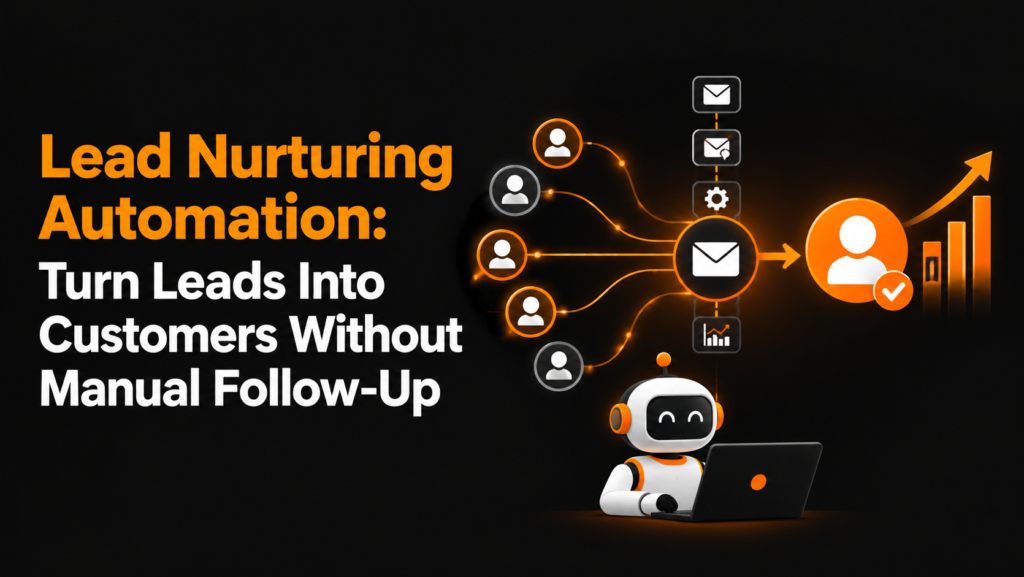
Most leads do not become customers the moment they submit a form, download a resource, request information, or start a conversation with your business. Some need more information. Others need proof that your solution works. Some are interested but not ready to buy, while others may be evaluating several providers at the same time.
The challenge is keeping every lead engaged without requiring your marketing or sales team to manually follow up with every person.
That is where lead nurturing automation comes in.
Lead nurturing automation uses predefined marketing workflows, behavioral signals, segmentation, lead scoring, and automated follow-up to move prospects through the customer journey. Instead of treating every lead identically, an automated system can deliver relevant information based on where a prospect is in the funnel and how they interact with your business.
A well-designed nurture system can help businesses:
- Respond to new leads faster
- Maintain consistent follow-up
- Segment prospects by interests and behaviors
- Identify sales-ready opportunities
- Reduce repetitive manual work
- Personalize communication at scale
- Improve the transition from marketing to sales
- Keep potential customers engaged for longer buying cycles
The goal is not simply to send more emails. The goal is to create a structured customer journey that moves the right prospects toward the right next step.
What Is Lead Nurturing Automation?
Lead nurturing automation is the use of software and predefined workflows to automatically communicate with prospects over time based on their characteristics, actions, interests, and position in the buying journey.
Traditional lead follow-up often depends on a salesperson remembering to contact someone at the right time. That approach becomes increasingly difficult as lead volume grows.
Automated lead nurturing replaces many repetitive tasks with a system that can trigger communication based on specific conditions.
For example, imagine a prospect downloads an article about marketing automation.
The system could:
- Capture the prospect’s information.
- Identify the topic that attracted them.
- Add them to a relevant nurture segment.
- Send educational content about marketing automation.
- Monitor their engagement.
- Increase their lead score when they take high-intent actions.
- Notify sales when their activity indicates buying intent.
- Continue nurturing them if they are not ready for a sales conversation.
This creates a continuous process instead of a collection of disconnected follow-up activities.
Why Lead Nurturing Matters
Generating leads is only the beginning of customer acquisition.
A business can have excellent traffic, strong landing pages, and effective lead-generation campaigns but still lose potential customers if those leads are not followed up consistently.
Many prospects require multiple interactions before they are comfortable making a purchasing decision.
They may need to understand:
- What your company does
- Which problem your solution solves
- Whether your approach is credible
- How your product or service compares with alternatives
- What implementation involves
- How much the solution may cost
- Whether your company is the right fit
Lead nurturing gives businesses a way to address these questions progressively.
Leads Are Often Not Ready to Buy
A new lead should not automatically be treated as a sales-ready opportunity.
Someone who downloads an introductory guide has demonstrated interest, but that does not necessarily mean they are ready for a sales call.
Another prospect may visit your pricing page several times, read service pages, open multiple emails, and request a consultation.
These two prospects should not receive the same follow-up.
This is why effective nurturing combines segmentation, behavioral tracking, and lead scoring.
Consistency Matters
Manual follow-up can be inconsistent.
A salesperson may follow up immediately with one lead but wait several days to contact another. A busy team may forget to follow up entirely.
Automation creates consistent communication while allowing salespeople to focus on conversations that require human judgment.
The Lead Nurturing Lifecycle
A complete nurture strategy typically follows several connected stages:
Capture → Segment → Nurture → Track → Score → Qualify → Sales Handoff → Continue Nurturing
Each stage serves a different purpose.
Stage 1: Capture the Lead
The lifecycle begins when someone provides their information or enters your marketing ecosystem.
Common lead-capture sources include:
- Website forms
- Landing pages
- Content downloads
- Webinar registrations
- Contact requests
- Demo requests
- Consultation forms
- Newsletter subscriptions
- Paid advertising campaigns
- Organic search
- Social media campaigns
The information captured at this stage determines how effectively the lead can be segmented later.
Useful fields may include:
- Name
- Email address
- Company
- Job role
- Industry
- Company size
- Primary interest
- Service requested
- Lead source
Avoid collecting unnecessary information simply because your form allows it. Excessive form fields can reduce conversion rates.
Stage 2: Segment the Lead
Once captured, the lead should be placed into an appropriate segment.
Segmentation allows automated lead nurturing to become more relevant.
A business could segment leads based on:
- Industry
- Company size
- Geographic market
- Service interest
- Buyer role
- Funnel stage
- Lead source
- Previous interactions
- Product interest
- Engagement level
For example, a person interested in marketing automation should not necessarily enter the same sequence as someone researching brand strategy.
Stage 3: Start the Nurture Sequence
The system then begins an appropriate sequence.
A basic sequence might provide:
- Immediate confirmation
- Educational content
- Helpful resources
- Case studies
- Product or service information
- Objection-handling content
- A relevant call to action
The sequence should gradually move from education toward evaluation and conversion.
Stage 4: Monitor Behavior
Automation should not operate as a simple timer that sends an email every three days.
The system should also consider what the prospect does.
Behavioral signals may include:
- Email opens
- Link clicks
- Website visits
- Pricing-page visits
- Content downloads
- Form submissions
- Webinar attendance
- Demo requests
- Consultation requests
- Repeat visits
- Engagement with specific topics
These actions provide clues about intent.
Stage 5: Score the Lead
Lead scoring assigns values to actions or characteristics that indicate potential buying intent.
For example:
| Lead Action | Example Score |
|---|---|
| Newsletter signup | +2 |
| Blog/resource download | +5 |
| Opens multiple emails | +3 |
| Clicks service-related content | +5 |
| Visits pricing page | +10 |
| Requests a consultation | +20 |
| Books a demo | +25 |
The exact values should be customized to the business.
The purpose is not to create an arbitrary number. The purpose is to establish a consistent framework for identifying stronger opportunities.
Stage 6: Qualify the Lead
Lead qualification automation can use a combination of:
- Lead score
- Company characteristics
- Engagement
- Service interest
- Buying signals
- Form responses
- Previous conversations
A high score alone does not always mean a lead is qualified.
For example, a student researching marketing automation could interact with many resources but have no purchasing authority.
That is why scoring should work alongside qualification criteria.
Stage 7: Hand Off to Sales
Once a lead reaches the appropriate threshold, the system can trigger a sales handoff.
Depending on the CRM and workflow, this could:
- Create a sales task
- Assign the lead to a representative
- Send an internal notification
- Update the lead stage
- Add relevant activity to the CRM
- Stop marketing emails
- Start a sales-oriented workflow
The goal is to ensure sales receives useful context rather than simply receiving a name and email address.
Stage 8: Continue Nurturing
Not every qualified lead will buy immediately.
If someone speaks with sales but does not convert, the system can place them into a longer-term nurture workflow.
This prevents leads from disappearing after a single sales interaction.
Lead Nurturing Automation Funnel
The following model shows how an automated nurture system can connect the major funnel stages:
                 LEAD CAPTURE
                      │
                      ▼
             ┌─────────────────┐
             │   SEGMENT LEAD  │
             └────────┬────────┘
                      │
                      ▼
             ┌─────────────────┐
             │ START SEQUENCE  │
             └────────┬────────┘
                      │
                      ▼
             ┌─────────────────┐
             │ TRACK BEHAVIOR  │
             └────────┬────────┘
                      │
                      ▼
             ┌─────────────────┐
             │   LEAD SCORING  │
             └────────┬────────┘
                      │
             ┌────────┴─────────┐
             ▼                  ▼
       LOW/UNREADY         HIGH INTENT
             │                  │
             ▼                  ▼
      LONG-TERM NURTURE    SALES QUALIFY
             │                  │
             │                  ▼
             │             SALES HANDOFF
             │                  │
             └────────┬─────────┘
                      ▼
                 CONVERSION
This funnel should be adapted to the actual customer journey of each business. Some companies may require additional qualification stages, while others may have shorter purchasing cycles.
How Automated Lead Nurturing Works
Automated lead nurturing generally operates through a combination of triggers, conditions, actions, and outcomes.
Triggers
A trigger starts a workflow.
Examples include:
- Form submission
- Resource download
- New contact creation
- Specific page visit
- Email interaction
- Lead score reaching a threshold
- Appointment request
Conditions
Conditions determine what happens next.
For example:
If the lead has visited the pricing page,
then send pricing-related content.
If the lead has not engaged for 30 days,
then move them into a re-engagement sequence.
If the lead score reaches 50,
then notify sales.
Actions
Actions are what the automation actually does.
These may include:
- Send an email
- Update a CRM field
- Add a tag
- Change lead status
- Assign a salesperson
- Create a task
- Increase or decrease a score
- Move the contact into another workflow
This logic makes automation more dynamic than a simple email autoresponder.
Lead Follow-Up Automation vs. Manual Follow-Up
Manual follow-up still has an important role in sales, particularly when a prospect is highly qualified or requires consultation.
However, manually managing every early-stage interaction creates unnecessary work.
| Manual Follow-Up | Lead Follow-Up Automation |
|---|---|
| Dependent on staff availability | Runs automatically |
| Can become inconsistent | Consistent timing |
| Difficult to scale | Easier to scale |
| Often generic | Can be behavior-based |
| Requires repetitive tasks | Automates repetitive actions |
| Limited by team capacity | Can handle larger lead volumes |
The strongest approach is usually not automation versus humans.
It is automation for repetitive communication + humans for high-value conversations.
Designing an Effective Nurture Sequence
A good sequence should answer the question:
What does this prospect need to know next?
The answer changes depending on funnel stage.
Top-of-Funnel Sequence
At the awareness stage, focus on education.
Potential content includes:
- Beginner guides
- Educational articles
- Industry insights
- Problem-focused content
- Checklists
- Research
Avoid pushing a hard sales message immediately unless the lead has already shown strong buying intent.
Middle-of-Funnel Sequence
At the consideration stage, the prospect understands the problem and is evaluating possible solutions.
Content can include:
- Detailed guides
- Comparisons
- Case studies
- Implementation explanations
- ROI information
- Expert insights
- FAQs
The objective is to help the prospect evaluate options.
Bottom-of-Funnel Sequence
At the decision stage, the prospect may need information that reduces friction.
Useful content includes:
- Pricing information
- Service details
- Case studies
- Testimonials
- Implementation timelines
- Consultation invitations
- Product demonstrations
- Objection-handling content
At this stage, a clear conversion action is appropriate.
Lead Nurturing Sequence Planning Table
Before building a workflow, map the sequence before writing individual emails.
| Funnel Stage | Prospect Need | Content | Trigger | Desired Action |
|---|---|---|---|---|
| Awareness | Understand the problem | Educational guide | New lead | Read content |
| Awareness | Learn possible solutions | Resource/article | Content engagement | Visit service page |
| Consideration | Compare approaches | Comparison guide | Multiple interactions | Review solution |
| Consideration | Build confidence | Case study | High engagement | Explore proof |
| Decision | Reduce uncertainty | FAQ/pricing content | High lead score | Request consultation |
| Sales-ready | Talk to an expert | Sales invitation | Score threshold | Book meeting |
| Not ready | Stay informed | Long-term nurture | No conversion | Continue engagement |
This planning process helps prevent businesses from creating disconnected campaigns.
Personalization in Lead Nurturing Automation
Automation does not have to mean impersonal communication.
In fact, one of its biggest advantages is the ability to personalize communication according to data.
For example, a workflow could distinguish between:
- Small businesses
- Enterprise organizations
- Marketing managers
- Business owners
- Existing customers
- New prospects
It could also change content based on what the person has previously viewed.
A prospect who repeatedly consumes content about AI automation could receive more advanced resources on that topic rather than generic marketing content.
Behavioral Personalization
Behavioral personalization is particularly useful because it responds to demonstrated interest.
For example:
Prospect A: Downloads a beginner marketing guide.
Prospect B: Visits the pricing page and service page three times.
They may have entered through the same campaign, but their behavior suggests different intent.
A strong workflow responds accordingly.
Lead Scoring and Nurturing
Lead scoring helps connect marketing activity with sales priorities.
A basic scoring model can combine two categories.
Demographic or Firmographic Score
This evaluates whether the lead fits the ideal customer profile.
Factors can include:
- Company size
- Industry
- Job title
- Location
- Revenue range
- Business model
Behavioral Score
This measures engagement.
Examples include:
- Content downloads
- Website visits
- Email clicks
- Service-page views
- Pricing-page visits
- Demo requests
- Consultation requests
Combining these signals can produce a more useful qualification system.
For example:
Fit score + engagement score = overall lead priority
The exact formula should be based on historical conversion data rather than arbitrary assumptions.
How to Build Lead Qualification Automation
Lead qualification automation should answer three basic questions:
Does the Lead Fit?
Determine whether the prospect matches your target customer profile.
Is the Lead Engaged?
Look at the actions the prospect has taken.
Is There Evidence of Intent?
Identify actions that indicate the prospect may be considering a purchase.
A workflow can then assign leads to categories such as:
- New
- Engaged
- Marketing qualified
- Sales qualified
- Opportunity
- Customer
- Disqualified
- Nurture later
Clear definitions are important because marketing and sales teams need to interpret these stages consistently.
Customer Journey Automation Beyond the First Conversion
Lead nurturing should not necessarily stop when a prospect becomes a customer.
The same automation infrastructure can support the broader customer journey.
For example:
NEW LEAD
   ↓
EDUCATION
   ↓
CONSIDERATION
   ↓
QUALIFICATION
   ↓
SALES
   ↓
CUSTOMER
   ↓
ONBOARDING
   ↓
RETENTION
   ↓
UPSELL / CROSS-SELL
   ↓
ADVOCACY
This is where customer journey automation becomes broader than traditional lead nurturing.
The system can help customers receive appropriate communications after purchase rather than continuing to receive acquisition-focused messages.
Common Lead Nurturing Workflow Examples
Different businesses require different workflows.
New Lead Welcome Workflow
Trigger: New form submission
Sequence:
- Immediate confirmation
- Helpful resource
- Educational article
- Relevant service information
- Case study
- Consultation CTA
Content Download Workflow
Trigger: Resource download
Sequence:
- Deliver resource
- Recommend related content
- Ask about the prospect’s challenge
- Provide a deeper guide
- Introduce the relevant solution
- Offer a consultation
High-Intent Workflow
Trigger: Pricing-page visit + high lead score
Sequence:
- Relevant solution information
- Case study
- FAQ or objection handling
- Consultation invitation
- Sales notification
Re-Engagement Workflow
Trigger: No engagement for a defined period
Sequence:
- New resource
- Relevant educational content
- Preference update
- Final re-engagement message
If there is still no engagement, the contact can be moved into a lower-frequency communication segment.
When Should Automation Hand Leads to Sales?
There is no universal lead score that means every prospect is sales-ready.
Instead, establish a threshold using your own conversion data.
For example, a business might define a sales-ready lead as someone who:
- Matches its ideal customer profile
- Has engaged with several high-value resources
- Has visited a commercial page
- Has demonstrated buying intent
- Has requested direct contact
The important part is creating an agreed definition between marketing and sales.
If marketing sends too many low-quality leads to sales, sales may stop trusting the automation system.
If the threshold is too high, valuable opportunities may remain in nurture too long.
Common Lead Nurturing Automation Mistakes
Automation can create significant efficiency, but poorly designed workflows can make customer experiences worse.
Sending Too Many Messages
More communication does not automatically mean better nurturing.
Excessive emails can cause:
- Unsubscribes
- Low engagement
- Brand fatigue
- Spam complaints
Set reasonable communication limits.
Using the Same Sequence for Everyone
A single generic sequence may ignore important differences in customer intent.
Segment whenever meaningful differences exist.
Over-Automating Sales Conversations
Automation should support human sales interactions, not replace conversations that require expertise.
When a prospect asks a complex question or demonstrates strong buying intent, the workflow should facilitate human contact.
Ignoring Negative Signals
Automation should respond not only to positive engagement but also to disengagement.
For example, repeated inactivity may indicate that the sequence needs to slow down or change.
Failing to Define Sales Handoff Rules
Marketing and sales should agree on:
- What qualifies as a sales-ready lead
- Which actions trigger a handoff
- Who receives the lead
- How quickly sales should respond
- What information sales needs
Without these rules, automation can create more confusion instead of less.
How to Measure Lead Nurturing Automation Performance
A nurture workflow should be measured against business outcomes, not just email metrics.
Important metrics include:
Lead-to-Customer Conversion Rate
How many nurtured leads eventually become customers?
MQL-to-SQL Conversion Rate
How effectively are marketing-qualified leads becoming sales-qualified leads?
Time to Conversion
How long does it take a nurtured lead to become a customer?
Sales Acceptance Rate
How many leads passed to sales are considered legitimate opportunities?
Engagement Rate
Measure useful interactions such as:
- Email clicks
- Content engagement
- Website visits
- Resource downloads
Revenue Influenced by Nurturing
Where possible, connect nurture workflows to pipeline and revenue data.
This provides a much stronger picture than measuring opens alone.
How to Implement Lead Nurturing Automation
A practical implementation process can be broken into several steps.
Step 1: Define the Ideal Customer
Document who you want to attract.
Step 2: Map the Customer Journey
Identify the stages from first interaction to purchase.
Step 3: Identify Lead Sources
Document where prospects enter your system.
Step 4: Create Segments
Group prospects according to meaningful differences.
Step 5: Define Lead-Scoring Rules
Identify behaviors and characteristics that indicate fit and intent.
Step 6: Map Your Workflows
Determine the trigger, conditions, messages, and next actions.
Step 7: Create Content
Build the resources required for each stage.
Step 8: Define Sales Handoff
Specify exactly when and how marketing-qualified leads reach sales.
Step 9: Test the Workflow
Test every branch before activating it.
Step 10: Measure and Improve
Review performance regularly and optimize based on actual conversion data.
Where AI Can Improve Lead Nurturing
AI can make automated lead nurturing more adaptive when it is integrated thoughtfully into the workflow.
AI-powered systems can help analyze:
- Lead behavior
- Engagement patterns
- Customer data
- Content interests
- Lead quality
- Historical conversion patterns
AI can also assist with content recommendations, segmentation, prioritization, and workflow optimization.
However, AI should operate within clearly defined business rules and quality controls.
The objective should be better decisions and more relevant customer experiences—not simply adding AI to every step.
For businesses looking to connect automation with broader marketing strategy, Fixody’s AI-Powered Marketing Automation service can be a natural next step for designing and implementing these systems.
Lead Nurturing Automation Checklist
Before launching a nurture workflow, check whether you have:
- Defined your ideal customer
- Identified lead sources
- Created meaningful segments
- Mapped funnel stages
- Defined lead-scoring criteria
- Created relevant content
- Established workflow triggers
- Defined follow-up timing
- Created sales handoff rules
- Added CRM updates
- Set communication limits
- Built re-engagement logic
- Tested every workflow branch
- Established conversion goals
- Connected reporting to business outcomes
A checklist can make implementation easier because automation projects often involve many small decisions that are easy to overlook.
CTA: Download the Lead Nurturing Workflow Checklist to map your capture, segmentation, sequencing, scoring, qualification, and sales-handoff process before launching your automation.
Final Takeaway
Lead nurturing automation is most effective when it is treated as a customer-journey system rather than an email-sending tool.
The strongest workflows connect five core functions:
Capture → Segment → Nurture → Score → Sales Handoff
When these stages work together, businesses can maintain consistent lead follow-up while giving sales teams more visibility into which prospects are genuinely ready for a conversation.
Automation should not make your marketing feel robotic. Done correctly, it should make your communication more relevant, timely, and useful.
For Fixody, this topic also naturally connects to the broader strategy of AI-powered marketing automation, where intelligent workflows can combine lead data, behavioral signals, segmentation, scoring, and customer journey automation to create a more scalable growth system.
Frequently Asked Questions
What is lead nurturing automation?
Lead nurturing automation uses automated workflows to communicate with prospects based on their characteristics, behavior, interests, and position in the buying journey. It helps businesses maintain consistent follow-up while moving qualified prospects toward sales.
How does automated lead nurturing work?
Automated lead nurturing typically captures a lead, assigns them to a segment, places them into a relevant sequence, tracks their engagement, adjusts their lead score, and eventually either sends them to sales or continues nurturing them.
What is the difference between lead nurturing and lead qualification?
Lead nurturing focuses on developing a relationship with a prospect through relevant communication and content. Lead qualification determines whether that prospect is a good fit and sufficiently interested to become a sales opportunity.
What is lead scoring?
Lead scoring is a system for assigning values to prospect characteristics and behaviors. Businesses can use scores to prioritize leads and determine when someone may be ready for sales engagement.
Can lead nurturing automation replace salespeople?
No. Automation can handle repetitive communication and qualification tasks, but salespeople remain important for consultations, complex questions, negotiation, relationship building, and closing opportunities.
How long should a lead nurturing sequence be?
There is no universal ideal length. The sequence should reflect the customer’s buying cycle, the complexity of the offer, and the amount of information prospects need before making a decision.
What types of content work best for lead nurturing?
Useful content can include educational articles, guides, case studies, comparisons, FAQs, research, implementation information, pricing explanations, and other resources that address questions prospects have at different funnel stages.
When should a nurtured lead be sent to sales?
A lead should generally be handed to sales when it meets your agreed qualification criteria, including sufficient customer fit and meaningful buying intent. The threshold should be based on your business’s historical conversion data.
What is customer journey automation?
Customer journey automation coordinates automated interactions across different stages of the customer lifecycle, from initial lead capture through nurturing, sales, onboarding, retention, and potentially expansion.
How do I know whether my lead nurturing automation is working?
Look beyond email opens. Track metrics such as lead-to-customer conversion, MQL-to-SQL conversion, sales acceptance, time to conversion, pipeline contribution, and revenue influenced by nurture workflows.