October 30, 2026 · admin
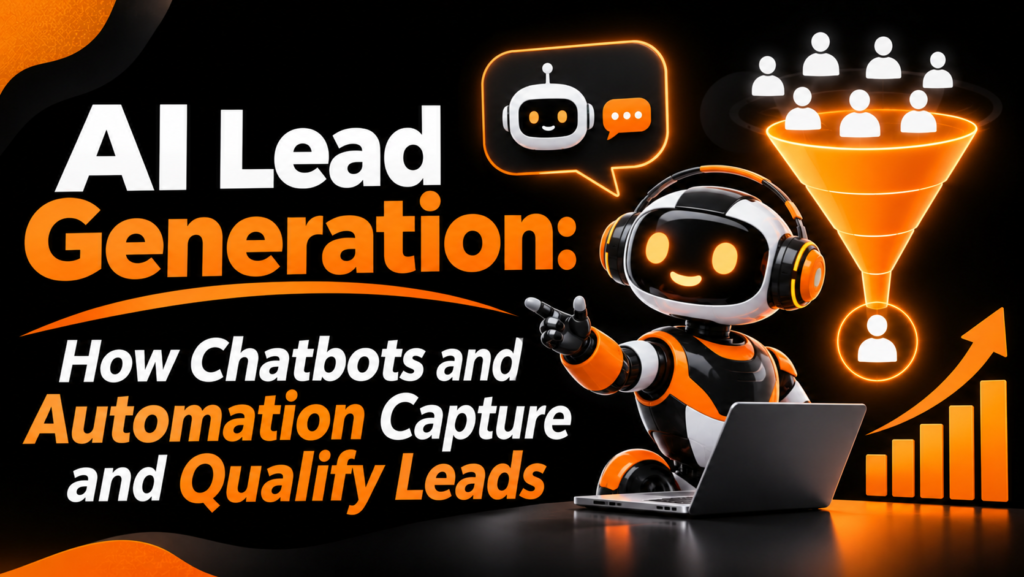
AI Lead Generation: How Chatbots and Automation Capture and Qualify Leads
Generating leads is only the first step toward growing a business. Companies also need to respond quickly, understand what prospects want, identify qualified opportunities, and guide potential customers toward the next action. When these tasks depend entirely on manual work, inquiries can go unanswered, sales teams can waste time on poor-fit prospects, and promising opportunities can disappear.
AI Lead Generation helps businesses improve this process by combining artificial intelligence, conversational chatbots, and marketing automation. Instead of relying only on static forms, businesses can engage visitors in real time, answer common questions, collect relevant information, and route qualified prospects to the right team.
For businesses exploring AI marketing services, the goal is not simply to add a chatbot to a website. It is to build a connected lead generation system that creates useful conversations and supports measurable sales outcomes.
This guide explains how AI chatbots capture and qualify leads, where they work best, when they can hurt conversions, and how to build an effective chatbot workflow for websites and WhatsApp.
What Is AI Lead Generation?
AI Lead Generation is the use of artificial intelligence and automated workflows to attract potential customers, engage them in conversations, collect relevant information, and identify promising sales opportunities.
Traditional lead generation often relies on contact forms, downloadable resources, email campaigns, and manual follow-up. AI-powered systems can add a conversational layer to these activities by helping visitors explain their needs in their own words.
For example, a visitor to a marketing agency’s website might ask how much automation services cost. An AI chatbot can explain the available service options, ask about the visitor’s business goals, collect contact details when appropriate, and offer to schedule a consultation.
Depending on its configuration, the system may also send the conversation summary to a CRM, assign a lead score, and notify a sales representative.
How AI Lead Generation Differs From Traditional Automation
Traditional automation follows predefined rules. For example, when someone submits a form, the system sends a confirmation email and creates a CRM record.
AI adds the ability to interpret natural-language questions, recognize intent, and respond using approved business information. It can make conversations more flexible without requiring a separate scripted response for every possible question.
However, AI does not replace the need for reliable workflow rules. Businesses still need to define when to collect information, how to qualify leads, when to involve a human, and which actions the chatbot is permitted to take.
The strongest systems combine AI conversation capabilities with predictable automation for tasks such as record creation, lead routing, appointment confirmation, and follow-up.
How AI Chatbots Capture and Qualify Leads
A chatbot should guide visitors through a useful conversation rather than immediately demand their contact information. The process works best when each question has a clear purpose.
1. Engage Visitors at the Right Moment
A website chatbot can greet visitors when they arrive, when they explore a relevant service page, or when they show signs of needing assistance.
For example, someone reading a page about marketing automation may benefit from an invitation to learn how automated workflows can improve their lead management process.
A relevant opening might be:
“Looking to generate and manage more qualified leads? I can help you explore the right automation options.”
Avoid displaying intrusive messages on every page or interrupting visitors before they have time to understand the offer. Engagement should support the visitor’s journey rather than distract from it.
2. Understand the Visitor’s Needs
AI chatbot lead generation can use conversational questions to understand why someone is visiting and what they want to accomplish.
Depending on the business, useful questions might include:
- What service are you interested in?
- What is the biggest challenge you are trying to solve?
- Are you looking for information, pricing, or a consultation?
- How soon are you planning to get started?
The chatbot should ask only questions relevant to the next step. It does not need to collect a complete customer profile during the first interaction.
Natural-language understanding can help interpret different answers that express the same intent. For example, “I want more demo bookings” and “We need more people scheduling product demos” may indicate a similar business goal.
3. Collect Contact Information Naturally
Once the chatbot understands the visitor’s needs, it can explain why contact details would be useful.
For example:
“I can arrange a consultation to discuss this. What business email should we use to send the available times?”
This approach gives the visitor a clear reason to share information instead of presenting an unexplained request for personal details.
Collect only the information needed to provide the requested service. Explain how the details will be used, respect applicable privacy requirements, and obtain any required consent before sending marketing communications.
4. Qualify Leads Using Business Rules
A chatbot conversation can provide useful signals for lead qualification. These may include the service requested, business type, stated goals, project timeline, and willingness to schedule a meeting.
A simple qualification framework can evaluate two dimensions:
Business fit: Does the prospect match the company’s target market and service capabilities?
Buying intent: Is the prospect asking about implementation, requesting a proposal, or booking a consultation?
For example, a B2B automation agency may prioritize a company that needs CRM integration and is ready to discuss implementation. A visitor who is only researching general concepts may be better suited to an educational follow-up.
AI can help interpret answers, but qualification decisions should use clear criteria. Sensitive or high-impact decisions should not be delegated to an unchecked model. Keep a human review path for ambiguous cases.
5. Route Qualified Leads to Sales
Once a prospect meets the relevant criteria, the chatbot workflow can create or update the CRM record, assign an owner, and notify the appropriate team member.
Routing may depend on the requested service, region, account ownership, or availability of a sales representative.
The workflow should also include fallback rules. If the chatbot cannot confidently determine the correct category or the integration fails, the conversation should be flagged for review rather than silently discarded.
6. Book Meetings and Trigger Follow-Up
When a visitor is ready to speak with someone, the chatbot can offer available appointment slots through a connected scheduling system.
After a successful booking, the workflow can send confirmation details, update the CRM, and notify the assigned representative.
If the visitor is not ready to book, the chatbot can offer a relevant resource or explain how to reconnect later. Any subsequent marketing follow-up should respect the person’s communication preferences and applicable consent requirements.
Example AI Chatbot Conversation Flow
A useful chatbot flow balances qualification with a smooth customer experience.
Example 1: Website Chatbot for a Marketing Agency
Visitor: Hi, I want to improve lead generation for my business.
Chatbot: I can help you explore some options. Are you mainly looking for more inquiries, better lead qualification, or automated follow-up?
Visitor: Better qualification and follow-up.
Chatbot: Understood. Are you currently managing leads through a CRM, spreadsheets, or another system?
Visitor: We use a CRM, but follow-up is still mostly manual.
Chatbot: Connecting your CRM to qualification and follow-up workflows may help. Would you like to discuss your current process with a specialist?
Visitor: Yes.
Chatbot: Great. You can book a consultation using our scheduling link. If you prefer, share your business email and we can help you with the next step.
In this example, the chatbot identifies the visitor’s goal, learns about the existing process, and offers a relevant next action. It does not need to ask ten questions before providing value.
Example 2: High-Intent Lead Qualification
Visitor: I need an AI chatbot for my website.
Chatbot: Are you looking to answer customer questions, capture leads, book appointments, or support all three?
Visitor: Capture leads and book appointments.
Chatbot: Which website platform or CRM are you currently using?
Visitor: WordPress and a CRM.
Chatbot: Thanks. Integration requirements can affect the setup. Would you like to schedule a consultation to review your website, CRM, and desired workflow?
This flow helps identify the required functionality before directing the prospect toward a consultation. The chatbot should avoid promising compatibility until the relevant integrations have been checked.
WhatsApp Chatbot Marketing: A Practical Use Case
WhatsApp chatbot marketing can be useful for businesses whose customers already use WhatsApp to ask questions, request quotes, or arrange appointments.
A business can connect an eligible WhatsApp Business Platform integration to a chatbot and automation system. The exact capabilities depend on the provider, account configuration, and approved integrations.
Consider a home services company that receives inquiries about installation projects. A potential customer sends a WhatsApp message asking for a quote.
The chatbot can ask which service is needed, request the general project location, and gather a few details about the job. It can then categorize the inquiry, create a CRM record, and route the request to the appropriate team.
If the prospect wants an appointment, the workflow can provide available booking options through a connected scheduling system. If the question requires a site assessment or a judgment call, the chatbot can transfer the conversation to a staff member.
A Sample WhatsApp Conversation
Customer: Hi, I want a quote for your service.
Chatbot: Thanks for contacting us. Which service are you interested in?
Customer: Installation.
Chatbot: I can help direct your request. What city or service area is the project in?
Customer: Rochester Hills.
Chatbot: Thank you. Would you like to share a brief description of the project, or would you prefer to speak with our team?
Customer: I want to speak with someone.
Chatbot: Certainly. I can direct your inquiry to our team so they can help with the next step.
The CRM can store the inquiry, service category, location, and preferred next step. A staff member can then review the request and follow up.
The chatbot should not invent prices, confirm service availability without verification, or claim that a booking has been completed unless the scheduling system confirms it.
Important WhatsApp Automation Considerations
Businesses should verify the current WhatsApp Business Platform requirements and the rules of their chosen provider before launching a workflow.
In particular:
- Obtain appropriate permission before sending marketing messages.
- Follow applicable message-template and conversation-window requirements.
- Provide a practical way for customers to reach a human.
- Protect customer information and limit access to conversation records.
- Test delivery failures, opt-outs, and handoffs to staff.
WhatsApp is most effective when automation makes it easier to get help, not when it creates another barrier between customers and the business.
Where AI Lead Generation Helps Most
AI-powered chatbots are not equally valuable in every situation. Their effectiveness depends on the complexity of the customer journey, the quality of the underlying information, and how well the chatbot connects to the rest of the business.
Lead Qualification
Chatbots can ask structured questions, identify likely intent, and separate routine inquiries from opportunities that need sales attention. This is especially useful when a business receives many inquiries with different levels of urgency.
Appointment Booking
When connected to a reliable scheduling tool, chatbots can help prospects choose a meeting time without waiting for a representative to respond manually.
Frequently Asked Questions
A chatbot can answer common questions about services, process, availability, or next steps using approved content. It should clearly acknowledge when information is unavailable rather than guessing.
After-Hours Lead Capture
A website chatbot can collect inquiries outside business hours and route them for follow-up during the next working period. It should set accurate expectations about when a human response will arrive.
CRM Updates and Lead Routing
Connected workflows can reduce repetitive data entry by recording conversation details, assigning lead owners, and triggering internal notifications.
Personalized Conversational Marketing
Conversational marketing can make lead capture more relevant by responding to a visitor’s stated needs. Personalization should be based on appropriate information and should not make visitors feel that the business is collecting unnecessary details about them.
When AI Chatbots Can Hurt Lead Generation
AI chatbots can also reduce conversions when they are poorly designed. Businesses should consider the risks before making chat the main path to a sale.
Asking Too Many Questions
A long qualification sequence can feel like an interrogation. If visitors must answer numerous questions before accessing basic information, they may leave.
What to do: Ask the minimum number of questions needed for the next action. Collect additional details later if they are genuinely useful.
Giving Incorrect or Invented Answers
An AI model may generate an answer that sounds convincing but is inaccurate. This can damage trust, especially when discussing pricing, contractual terms, service eligibility, or technical capabilities.
What to do: Ground answers in approved business information, restrict unsupported claims, and route uncertain questions to a human.
Blocking Human Support
Some visitors have complicated questions or simply prefer speaking with a person. A chatbot that repeatedly refuses to transfer them can create frustration.
What to do: Offer a clear human handoff option and explain what happens after the conversation is transferred.
Using Poorly Timed Pop-Ups
Repeated or immediate chat invitations can interrupt visitors who are still reading or comparing options.
What to do: Use relevant page context and engagement signals to decide when to offer help. Make it easy to dismiss the invitation.
Sending Unwanted Follow-Up Messages
Collecting a phone number or email address does not automatically mean the visitor has agreed to every type of marketing communication.
What to do: Explain the intended communication, honor opt-outs, and apply the appropriate consent and messaging rules.
Automating Without Measuring Results
A chatbot may generate many conversations without producing qualified leads or revenue.
What to do: Evaluate qualified conversations, completed bookings, sales acceptance, conversion rates, and customer feedback rather than focusing only on total chats.
How to Build an Effective AI Lead Generation System
A successful implementation starts with a defined business objective and expands as results become clear.
Step 1: Choose One High-Value Use Case
Start with a specific problem, such as qualifying demo requests, capturing after-hours inquiries, or booking consultations. A narrow objective makes it easier to design, test, and measure the workflow.
Step 2: Map the Conversation
List the most common visitor questions, the information the business needs, and the actions the chatbot can take. Include alternative paths for visitors who are not ready to share details or who need human assistance.
Step 3: Prepare Approved Knowledge
Create reliable answers about your services, processes, pricing policies, and common questions. Identify which questions the chatbot may answer independently and which require review.
Step 4: Connect the CRM and Business Tools
Configure contact creation, duplicate detection, lead qualification, assignment, scheduling, and notifications. Verify that information moves correctly between systems.
Step 5: Define Handoff and Failure Rules
Decide when the chatbot should transfer a conversation, flag uncertainty, or stop a workflow. Create a fallback process for unavailable staff, integration failures, and incomplete records.
Step 6: Test With Realistic Scenarios
Test straightforward questions, unusual phrasing, missing information, incorrect assumptions, and requests for a human. Verify the entire process from the first message to CRM updates and follow-up.
Step 7: Measure and Improve
Review conversation drop-off, lead quality, booking rates, sales acceptance, response times, and customer feedback. Use the findings to improve the conversation and remove unnecessary steps.
Metrics to Measure AI Lead Generation Performance
Track metrics that connect chatbot activity to business results.
Engaged conversation rate: The percentage of eligible visitors who begin a meaningful chatbot conversation.
Lead capture rate: The percentage of chatbot conversations that result in a valid lead record.
Qualification rate: The percentage of captured leads that meet your defined qualification criteria.
Booking conversion rate: The percentage of relevant conversations that lead to a completed appointment booking.
Sales acceptance rate: The share of qualified chatbot leads accepted by the sales team.
Lead-to-customer conversion rate: The percentage of leads that eventually become customers within a defined measurement period.
Cost per qualified lead: The eligible chatbot, software, campaign, and operating costs divided by the number of qualified leads generated.
Human handoff rate: The proportion of conversations transferred to a person. This is not automatically a negative metric; a well-designed chatbot should escalate complex or sensitive inquiries when necessary.
Compare chatbot-generated leads with other acquisition channels and account for differences in traffic, audience intent, and sales-cycle length. That will provide a more useful view of performance than total conversation volume alone.
Why Businesses Use AI Marketing Services
Building a chatbot involves more than choosing an AI model. Businesses need to plan the conversation, organize approved content, integrate their systems, protect customer information, and establish a way to measure outcomes.
AI marketing services can help businesses identify suitable use cases, configure chatbot workflows, connect CRM systems, and create processes for qualification and follow-up.
When evaluating a provider, ask how it handles:
- Website and messaging-channel integration
- CRM field mapping and lead assignment
- Knowledge sources and answer accuracy
- Human handoff and escalation
- Privacy, access controls, and consent
- Testing, analytics, and ongoing optimization
A good implementation should make the customer journey simpler and give the sales team better information. It should not add unnecessary complexity to an already difficult process.
Request an AI Chatbot Setup Consultation With Fixody
If your business receives inquiries through its website, forms, or WhatsApp, a well-designed chatbot may help you respond more consistently, qualify prospects, and organize follow-up.
Fixody can help you explore marketing automation workflows that connect lead capture, CRM processes, and follow-up activities. The right setup depends on your current tools, customer journey, and business goals.
Request a chatbot setup consultation with Fixody to discuss your lead generation process, identify the most useful automation opportunities, and determine which integrations your business needs.
Start with one clear use case and a measurable goal. Then expand the workflow when the results show that it is helping your business generate better opportunities.
Frequently Asked Questions
What is AI Lead Generation?
AI Lead Generation uses artificial intelligence and automation to engage potential customers, collect relevant information, qualify prospects, and guide them toward actions such as booking a meeting or requesting a quote.
How do AI chatbots generate leads?
AI chatbots generate leads by answering questions, understanding visitor intent, asking relevant qualification questions, collecting contact details when appropriate, and connecting prospects with sales teams or booking systems.
Can AI chatbots qualify leads automatically?
Yes. Chatbots can collect information and apply defined qualification rules based on customer fit, stated needs, and buying intent. AI can help interpret conversational responses, while business rules and human review help keep qualification decisions reliable.
Is WhatsApp chatbot marketing effective for businesses?
WhatsApp chatbot marketing can help businesses manage inquiries, answer routine questions, qualify prospects, and route conversations to the appropriate team. Results depend on audience preferences, the quality of the workflow, integration reliability, and compliance with messaging requirements.
What is the difference between a rule-based chatbot and an AI chatbot?
A rule-based chatbot follows predefined decision paths and scripted responses. An AI chatbot can interpret natural-language messages and respond more flexibly using its configured knowledge sources. Both can be connected to automation workflows for tasks such as lead routing and appointment booking.
Can AI lead generation integrate with a CRM?
Yes. Depending on the platform and available integrations, chatbot workflows can create or update contact records, record lead sources, assign owners, add conversation summaries, and trigger follow-up tasks. Integration behavior should be tested before launch.
How much does AI chatbot lead generation cost?
Costs vary according to chatbot complexity, messaging volume, integrations, AI usage, ongoing maintenance, and implementation requirements. A simple website chatbot typically requires fewer components than a system connecting multiple channels, a CRM, appointment booking, and advanced qualification logic. Request a scoped estimate based on your business needs.
Should every business use an AI chatbot?
No. A chatbot is most useful when it solves a real problem, such as handling repetitive questions, capturing after-hours inquiries, or qualifying a high volume of leads. A simple contact form and reliable human follow-up may be sufficient for businesses with low inquiry volumes or highly specialized sales conversations.