
October 24, 2026 · admin
Behavioral Segmentation With AI: Send the Right Message at the Right Moment
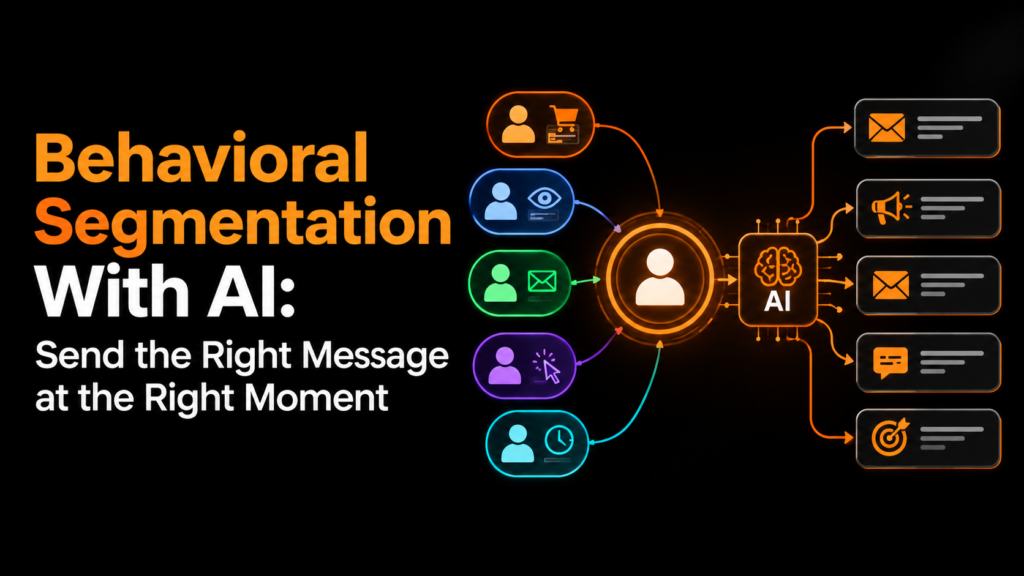
Modern customers interact with businesses across websites, emails, ads, social platforms, forms, and other digital channels. These interactions create valuable behavioral signals that can help marketers understand what people are interested in and where they are in the buying journey.
AI Audience Segmentation takes this process further by using customer data and artificial intelligence to identify patterns, create dynamic segments, and help marketers deliver more relevant messages.
Instead of placing every contact into a broad category such as age, location, or industry, AI can analyze what customers actually do. Someone who repeatedly views a pricing page, for example, may need a very different message from someone who has only downloaded an introductory guide.
The result is a more responsive approach to personalized marketing, where the message can change as customer behavior changes.
What Is AI Audience Segmentation?
AI Audience Segmentation is the process of using artificial intelligence to analyze customer and prospect data and organize people into meaningful groups based on shared characteristics, behaviors, interests, or patterns.
Traditional segmentation may rely on manually created rules. AI can help identify relationships across larger datasets and support segments that change as new customer activity is recorded.
Behavioral signals can include:
- Pages viewed
- Products or services researched
- Emails opened
- Links clicked
- Forms completed
- Content downloaded
- Previous purchases
- Website visits
- Cart activity
- Consultation or demo requests
- Engagement frequency
- Time since a previous interaction
These signals can be combined to create more useful customer segments.
Behavioral Segmentation vs. Demographic Segmentation
Behavioral and demographic segmentation answer different questions.
What Is Demographic Segmentation?
Demographic segmentation groups people according to relatively stable characteristics.
Examples include:
- Age range
- Gender
- Location
- Job title
- Company size
- Industry
- Income range
For B2B businesses, demographic or firmographic information can be particularly useful for identifying the type of organization or decision-maker involved.
However, demographic information does not necessarily tell you what someone wants right now.
Two customers can have nearly identical demographic profiles while being at completely different stages of the buying process.
What Is Behavioral Segmentation?
Behavioral segmentation focuses on what people do and how they interact with a business.
For example, a marketer might create a segment for contacts who:
- Visited a pricing page twice within seven days
- Opened several product emails
- Downloaded a comparison guide
- Started but did not complete a form
- Purchased within the previous 30 days
- Have not engaged with the brand for six months
These behaviors can provide stronger context for deciding what message should come next.
Why Combine Both Types?
Demographic and behavioral data can work together.
A company could identify small-business owners as one broad audience and then use behavior to determine whether each person is researching, comparing, purchasing, onboarding, or disengaging.
This creates a more detailed understanding of the customer without relying on demographics alone.
How AI Builds Dynamic Segments
One of the biggest advantages of AI-supported segmentation is the ability to work with changing customer behavior.
A traditional segment might say:
Customers who purchased a product.
An AI-supported approach can incorporate additional signals such as purchase history, recent website activity, email engagement, product interest, and time since purchase.
Collect Behavioral Signals
The process begins with collecting relevant first-party data from sources such as:
- Website analytics
- CRM systems
- Email platforms
- Ecommerce platforms
- Forms
- Customer-support systems
- Marketing automation platforms
The quality of the resulting segments depends heavily on the quality and completeness of these inputs.
Identify Behavioral Patterns
AI can analyze customer activity to identify patterns that may not be obvious from individual actions.
For example, a contact who visits several educational pages may simply be researching. Another visitor who views pricing, case studies, and a service page within a short period may demonstrate stronger purchase intent.
These patterns can help marketers create more meaningful groups.
Create Dynamic Segments
Dynamic segments change when customer behavior changes.
A contact might initially belong to an educational-content segment. After repeatedly visiting product pages, they may move into a high-intent segment.
After purchasing, they can automatically leave the prospect workflow and enter an onboarding or retention journey.
This reduces the need for marketers to manually update lists every time customer behavior changes.
5 Examples of AI Behavioral Segmentation
The value of behavioral segmentation becomes clearer when it is connected directly to messaging.
1. High-Intent Website Visitors
Behavior: A visitor repeatedly views pricing, service, or product pages and returns to the website within a short period.
Segment: High-intent prospects.
Matching message: Offer a consultation, demo, pricing guidance, or direct sales assistance rather than another basic educational article.
The objective is to make the next interaction relevant to the prospect’s apparent buying stage.
2. Content Researchers
Behavior: A visitor reads multiple educational articles and downloads guides but has not viewed pricing or requested a consultation.
Segment: Research-stage prospects.
Matching message: Send educational content such as comparison guides, case studies, webinars, or practical resources.
This approach helps nurture the prospect without pushing for a purchase too early.
3. Engaged Email Subscribers
Behavior: A subscriber consistently opens emails and clicks links related to a particular topic.
Segment: Highly engaged subscribers with a specific interest.
Matching message: Send additional content, offers, or resources related to the subject they repeatedly engage with.
Repeated interaction can provide useful signals about content preferences.
4. Abandoned Conversion Actions
Behavior: A visitor starts a signup, consultation request, application, or checkout process but does not complete it.
Segment: Abandoned conversion opportunities.
Matching message: Send a helpful reminder or provide information addressing common barriers to completion.
The message should be based on the action that was abandoned rather than sending a generic promotional email.
5. At-Risk Customers
Behavior: A previously active customer has stopped logging in, purchasing, opening emails, or engaging with the business.
Segment: Customers showing declining engagement.
Matching message: Send a re-engagement message, helpful resource, product update, support offer, or relevant incentive.
The purpose is to respond to declining engagement before the customer becomes completely inactive.
How Dynamic Segments Support Personalized Marketing
Personalized marketing becomes more useful when personalization reflects actual customer intent.
Simply adding someone’s first name to an email is a basic form of personalization. Behavioral segmentation can create much deeper personalization by changing the content, timing, offer, or channel according to customer activity.
Personalize the Message
Different behavioral groups can receive different content.
A first-time researcher may receive educational information, while a high-intent visitor may receive a consultation invitation.
Personalize Timing
Trigger-based marketing can respond to events instead of relying entirely on a fixed calendar.
For example, an automated workflow might send a follow-up after someone downloads a guide or alert a sales representative after a prospect demonstrates repeated high-intent behavior.
Personalize the Customer Journey
Dynamic segments can also determine which automation path a person enters.
Someone who becomes a customer should not continue receiving emails designed for unqualified prospects.
Likewise, a customer who has stopped engaging may need a retention workflow rather than another acquisition message.
Trigger-Based Marketing and AI Segmentation
Trigger-based marketing uses specific customer actions or conditions to start automated communications.
Common triggers include:
- Form submissions
- Product views
- Email clicks
- Purchases
- Trial activation
- Cart abandonment
- Consultation bookings
- Website activity
- Changes in customer status
AI can add another layer by helping interpret multiple signals rather than relying on one isolated action.
From Single Triggers to Behavioral Patterns
A single page view may not mean much.
But several pricing-page visits combined with a case-study download and repeated email engagement may represent a stronger buying signal.
AI-supported segmentation can help marketers evaluate these patterns and build workflows around more meaningful customer behavior.
Data Quality Is Critical for AI Audience Segmentation
AI can only work with the data available to it. Poor-quality customer data can produce inaccurate segments and irrelevant messaging.
Keep Customer Data Accurate
Important data-quality practices include:
- Remove duplicate customer records
- Standardize important fields
- Keep contact information current
- Track meaningful events consistently
- Define customer lifecycle stages clearly
- Maintain accurate CRM records
- Monitor tracking errors
- Document how behavioral events are captured
Use Relevant Data
Not every available data point needs to be used.
Focus on behavioral signals that actually help answer marketing questions.
For example, knowing that someone visited a particular service page may be more useful for a sales workflow than collecting dozens of unrelated engagement signals.
Respect Privacy Requirements
Customer data should be collected, stored, and used according to applicable privacy requirements and the company’s policies.
Businesses should understand what data they are collecting, why they are collecting it, how long it is retained, and how it is used in automated marketing workflows.
Common AI Segmentation Mistakes
AI does not automatically guarantee better marketing.
Several problems can reduce the effectiveness of an AI segmentation strategy.
Creating Too Many Segments
If every small behavioral difference creates a separate audience, campaigns can become difficult to manage.
Start with a few segments connected to clear business objectives.
Using Poor Behavioral Signals
Not every action indicates purchase intent.
A visitor may accidentally click a page or open an email without having meaningful buying interest.
Behavior should be evaluated in context.
Ignoring Segment Exit Conditions
A customer should not remain in the same automation workflow forever.
Define conditions that move people into new segments when their behavior changes.
Sending Too Many Messages
Behavioral targeting should make communication more relevant, not create excessive communication.
Frequency limits and suppression rules should be part of the automation strategy.
Failing to Test Segments
Segments should be monitored to determine whether they actually improve business outcomes.
Test different rules, messages, timing, and offers instead of assuming that an AI-generated audience will automatically perform better.
How to Build an AI-Powered Behavioral Segmentation Strategy
A practical implementation can start with a relatively simple framework.
Step 1: Define the Business Goal
Decide what you want segmentation to improve.
Possible goals include:
- Increasing qualified leads
- Improving conversion rates
- Increasing customer retention
- Improving email engagement
- Reducing churn
- Increasing repeat purchases
Step 2: Map Important Customer Behaviors
Identify the actions that indicate meaningful customer intent.
Focus on behaviors that can influence a marketing or sales decision.
Step 3: Connect Your Data Sources
Bring relevant website, CRM, email, sales, and customer data together where appropriate.
Consistent data collection is essential for creating useful dynamic segments.
Step 4: Define Initial Customer Segments
Start with a manageable number of groups.
For example:
- New prospects
- Research-stage prospects
- High-intent prospects
- New customers
- Existing customers
- At-risk customers
Step 5: Create Automation Rules
Define what happens when someone enters or leaves each segment.
This could trigger an email, CRM task, sales notification, content recommendation, or another workflow action.
Step 6: Establish Exit Conditions
Make sure customers automatically move between workflows when their behavior changes.
For example, someone who books a consultation should leave a prospect-nurturing sequence and enter the appropriate next-stage workflow.
Step 7: Measure Results
Track whether the segments produce better outcomes.
Useful metrics include conversion rate, engagement, sales-qualified leads, customer retention, revenue, and unsubscribe rates.
The Future of Behavioral Segmentation
As businesses collect more first-party customer data and marketing platforms become more capable, segmentation is moving beyond static lists.
The most useful systems will increasingly connect customer behavior with context, lifecycle stage, intent, and previous interactions.
Instead of asking only, “Who is this customer?” marketers can also ask:
- What has this customer done?
- What are they interested in?
- Where are they in the buying journey?
- What should happen next?
- Which message is most relevant right now?
That shift is at the heart of AI Audience Segmentation.
Make Every Customer Interaction More Relevant
Behavioral segmentation allows businesses to respond to customer actions rather than treating every contact the same way. AI can help analyze larger amounts of behavioral data, identify patterns, and support dynamic segments that change as customers move through the lifecycle.
The most effective approach is not to automate everything at once. Start with a small number of high-value customer segments, make sure the underlying data is accurate, define clear triggers and exit conditions, and measure the results.
When behavioral data, automation, and personalized marketing work together, businesses can deliver more relevant messages at the moments when those messages are most useful.
Frequently Asked Questions
What is AI Audience Segmentation?
AI Audience Segmentation uses artificial intelligence to analyze customer data and group audiences according to behaviors, interests, characteristics, and patterns. Unlike static audience lists, AI-powered segmentation can help businesses identify changing customer intent and create more relevant marketing experiences.
What is the difference between behavioral and demographic segmentation?
Demographic segmentation groups people using characteristics such as age, location, job title, industry, or company size. Behavioral segmentation focuses on actions such as website visits, email clicks, purchases, downloads, and form submissions. Combining both can provide a more complete view of the customer.
How does AI create dynamic customer segments?
AI can analyze behavioral data from sources such as websites, CRM systems, email platforms, and marketing automation tools. It identifies patterns and uses those signals to help organize customers into dynamic segments that can change as their behavior changes.
What are examples of behavioral segmentation?
Examples include high-intent website visitors, content researchers, highly engaged email subscribers, abandoned conversion opportunities, and customers showing signs of declining engagement. Each segment can receive a different message based on its behavior and lifecycle stage.
How does behavioral segmentation improve personalized marketing?
Behavioral segmentation helps marketers tailor messages based on what customers actually do. Instead of sending the same campaign to everyone, businesses can adjust content, offers, timing, and follow-up based on customer interests and actions.
What is trigger-based marketing?
Trigger-based marketing automatically starts a communication or workflow when a specific customer action or condition occurs. Examples include sending an email after a form submission, following up after a content download, or notifying sales when a prospect demonstrates strong buying intent.
What data is needed for AI Audience Segmentation?
Useful data can include website activity, email engagement, purchases, CRM information, form submissions, content downloads, product interactions, and customer lifecycle information. Accurate, consistent, and properly tracked data is important for producing useful segments.
Can AI segmentation be used by small businesses?
Yes. Small businesses can use AI-powered segmentation to organize leads and customers based on behaviors such as form submissions, email engagement, website activity, purchases, and appointment bookings. Starting with one or two high-value workflows can make implementation more manageable.
How do I measure the success of AI Audience Segmentation?
Measure results using metrics such as conversion rate, lead-to-customer rate, email engagement, sales-qualified leads, customer retention, revenue, and unsubscribe rates. Compare performance against a baseline to determine whether segmentation is improving business outcomes.
What are dynamic segments?
Dynamic segments are customer groups that automatically change when a person’s data or behavior changes. For example, a prospect can move from a research segment to a high-intent segment after repeated pricing-page visits and then enter an onboarding segment after becoming a customer.
What is lifecycle marketing automation?
Lifecycle marketing automation uses automated workflows to communicate with customers throughout their relationship with a business. It can include lead nurturing, conversion follow-up, onboarding, retention, renewal, and re-engagement campaigns. Behavioral segmentation can help determine which lifecycle workflow is most appropriate for each customer.