October 16, 2026 · admin
AI Marketing Automation Pricing: 15 Questions on Cost, ROI and Timelines
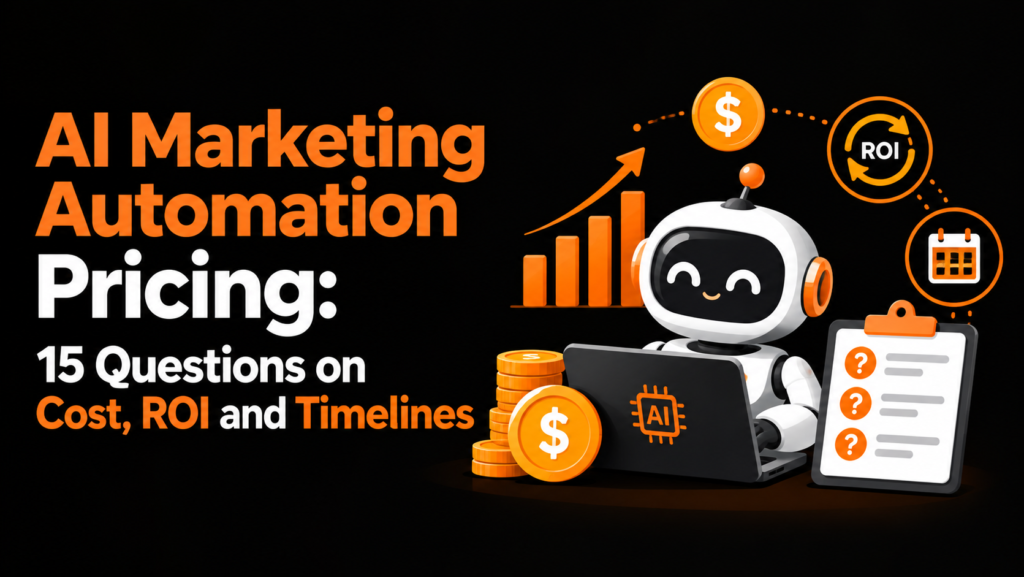
Understanding AI marketing automation cost is essential before investing in automated lead generation, customer follow-up, email marketing, or AI-powered workflows. Although automation can reduce repetitive work and improve marketing consistency, the total investment depends on your business goals, existing technology, data quality, and implementation requirements.
Some businesses need only a simple email sequence, while others require CRM integrations, lead scoring, AI-assisted content workflows, and multi-step reporting systems. These projects have different levels of complexity, which is why a single price rarely applies to every business.
This guide answers 15 common questions about AI marketing automation pricing, project timelines, return on investment, agency services, and implementation risks. It also explains how to compare in-house development with professional support so you can make an informed decision.
AI Marketing Automation Cost: 15 Questions Answered
1. How Much Does AI Marketing Automation Cost?
AI marketing automation cost depends on the scope of work rather than the technology label alone. A basic workflow that sends follow-up emails after a form submission requires less configuration than a system connecting multiple platforms, qualifying leads, and generating performance reports.
The total budget may include:
- Initial strategy and workflow planning.
- Software subscriptions and AI usage fees.
- CRM setup and data integration.
- Workflow configuration and testing.
- Content creation and personalization.
- Staff training, maintenance, and ongoing optimization.
To understand your likely investment, begin by defining the specific process you want to improve. Ask providers to separate setup costs, recurring software expenses, and ongoing management fees.
For accurate budgeting, request a proposal based on your actual requirements rather than relying on generic industry averages.
2. What Factors Affect Marketing Automation Pricing?
Marketing automation pricing is influenced by several practical factors.
Workflow complexity: A single welcome email is relatively straightforward. A workflow involving multiple triggers, customer segments, conditional logic, and sales handoffs requires more planning and testing.
Number of integrations: Connecting a website form to one CRM is different from synchronizing several marketing, sales, analytics, and customer support platforms.
Data quality: Incomplete contact records, duplicate entries, inconsistent fields, and outdated information can require additional cleanup before automation works reliably.
AI functionality: AI-assisted classification, content generation, and advanced decision-making can introduce additional configuration, usage fees, and quality-control requirements.
Ongoing support: Businesses may need monitoring, troubleshooting, reporting, and continuous improvements after implementation.
When comparing proposals, make sure each provider is pricing the same deliverables. Otherwise, an apparently cheaper quote may exclude important work.
3. Is AI Marketing Automation More Expensive Than Traditional Automation?
Not necessarily. The difference depends on the task being automated.
Traditional automation follows predefined rules. For example, every new subscriber might receive a welcome email, or every unanswered inquiry might create a reminder for a salesperson.
AI-powered automation can add capabilities such as classifying free-text inquiries, summarizing customer conversations, or helping personalize messages based on relevant information.
These capabilities may require additional AI subscriptions, usage charges, testing, and safeguards. However, they can also reduce manual work in processes where conventional rules are insufficient.
The sensible approach is to use traditional automation for predictable tasks and introduce AI only where it provides a clear benefit.
4. What Is Included in Marketing Automation Services?
Professional marketing automation services may cover the planning, implementation, integration, and ongoing management of automated workflows.
Depending on the agreement, services can include:
- Marketing process audits.
- Customer journey and workflow mapping.
- CRM configuration and lead routing.
- Email sequence development.
- AI tool integration.
- Data cleanup and field mapping.
- Testing and error handling.
- Reporting dashboards and performance reviews.
- Team training and documentation.
Not every project needs every service. A small business may benefit most from automating lead follow-up, while a larger organization may need coordinated workflows across several departments.
Before signing an agreement, ask which deliverables are included, which software licenses you must purchase separately, and what happens when requirements change.
5. Should You Hire a Marketing Automation Agency or Build In-House?
The choice between in-house vs agency automation depends on your team’s skills, available time, and the complexity of the project.
An in-house approach gives your employees direct control over the system. It can be suitable when someone already understands your CRM, marketing processes, and integrations.
A marketing automation agency may be a better fit when your business lacks implementation expertise, needs several systems connected, or wants an external team to help establish a reliable process.
Compare the full costs rather than salary against agency fees alone. In-house projects can involve employee time, training, software, maintenance, and troubleshooting. Agency projects can involve setup fees, retainers, and additional charges for work outside the agreed scope.
Ask both options to provide a defined implementation plan, responsibilities, timeline, and ongoing ownership arrangements.
6. How Much Does an AI Marketing Agency Charge?
An AI marketing agency may charge a fixed project fee, a monthly retainer, hourly consulting fees, or a combination of these models.
A fixed project fee can work well when the deliverables are clearly defined, such as building a lead qualification workflow or integrating a website form with a CRM.
Monthly retainers may suit businesses that require continuing optimization, campaign management, reporting, or technical support.
Hourly consulting can be appropriate for audits, troubleshooting, or targeted technical assistance.
Actual fees vary with project scope, provider expertise, integration requirements, and support expectations. Fixody’s specific project ranges should be confirmed directly rather than assumed from general market estimates.
Request an itemized proposal explaining what you receive, what is excluded, and how additional work is billed.
7. How Long Does AI Marketing Automation Take to Implement?
Implementation timelines depend on how many workflows you need, how well your existing systems work together, and whether your data is ready.
A straightforward workflow may be configured and tested relatively quickly. Projects involving several integrations, data migration, complex approval processes, or custom development typically require more coordination.
A practical project plan includes four stages:
- Discovery: Define business goals, existing processes, and success metrics.
- Design: Map the workflow, triggers, conditions, and customer communications.
- Implementation: Configure integrations, automation rules, and AI features.
- Testing and launch: Check accuracy, permissions, notifications, and exception handling before going live.
Ask your provider to distinguish the time required for initial launch from the time needed to evaluate meaningful business results.
8. How Soon Can You See Results From AI Marketing Automation?
Results depend on the workflow and the metric you are measuring.
Operational improvements, such as fewer manual data-entry tasks or faster notifications, may become visible soon after a workflow is launched.
Commercial outcomes, including increased conversion rates, repeat purchases, or lower customer acquisition costs, generally require more observation. Results can be affected by lead quality, traffic volume, pricing, sales performance, and customer demand.
Establish a baseline before implementation. If your team currently takes several hours to process incoming leads, record that time. If you want to improve conversion rates, document the existing rate and how it is calculated.
Review early operational indicators first, then evaluate business outcomes using enough data to make a meaningful comparison.
Avoid providers who promise a specific revenue increase without understanding your current performance and business conditions.
9. How Do You Calculate the ROI of Marketing Automation?
Marketing automation ROI compares the measurable financial benefits of a project with its total cost.
A simplified formula is:
ROI = (Financial Benefits − Total Costs) ÷ Total Costs × 100
For example, a business might evaluate additional gross profit attributable to improved follow-up, measurable labor savings, and reduced administrative expenses.
Consider a hypothetical project costing $5,000 that produces $8,000 in measurable financial benefits over a defined period. Its simplified ROI would be 60%.
This is an illustration, not a Fixody case study or a prediction of expected performance. Actual calculations should use your project’s real costs and defensible estimates of the benefits attributable to automation.
Include setup fees, subscriptions, AI usage, maintenance, and staff time in the cost calculation. Avoid counting the same benefit twice, such as recording saved employee time as both reduced payroll and additional profit without accounting for the difference.
10. What Data Do You Need Before Implementing AI Marketing Automation?
The required data depends on the workflow, but most projects benefit from accurate contact records, consistent customer identifiers, and clearly defined business events.
For lead follow-up, you may need contact details, inquiry source, service interest, and lead status.
For customer reactivation, you might need purchase history, previous interactions, and the date of the last relevant activity.
For reporting, you may need campaign identifiers, conversion events, sales outcomes, and reliable tracking across platforms.
Before implementation:
- Remove unnecessary duplicate records.
- Standardize important fields.
- Confirm that integrations transfer information correctly.
- Document the source of key metrics.
- Apply appropriate consent, access, and retention controls.
- Avoid sending sensitive customer data to AI services without reviewing privacy and security requirements.
Clean, relevant data is usually more valuable than collecting large amounts of information without a defined purpose.
11. Can a Small Business Afford Marketing Automation?
Yes. Small businesses can start with a narrow workflow instead of purchasing an extensive automation platform.
For example, a business could begin by automatically acknowledging website inquiries and notifying the appropriate employee. Once that process is reliable, it could introduce follow-up reminders, contact segmentation, and performance reporting.
To keep costs manageable, use existing software where practical, prioritize features that solve immediate problems, and avoid paying for tools that duplicate current capabilities.
A phased approach also makes it easier to determine whether the initial investment delivers enough value to justify expansion.
Affordable marketing automation should still include adequate testing, access controls, and a plan for maintaining the workflow. Cutting these essentials can create expensive problems later.
12. What Are the Most Common Reasons Automation Projects Fail?
Automation projects often struggle because businesses automate an unclear or inefficient process instead of improving it first.
Common failure points include:
- Unclear goals: The project has no defined business outcome.
- Poor data quality: Missing or inconsistent information causes incorrect actions.
- Disconnected systems: Integrations fail to synchronize important updates.
- Excessive complexity: Too many workflows are launched before the basic process is stable.
- Weak testing: Errors, duplicate messages, and incorrect routing go unnoticed.
- Insufficient ownership: Nobody is responsible for monitoring or updating the system.
- Unrealistic expectations: Business outcomes are promised without considering traffic, lead quality, or sales capacity.
Prevent these issues by starting with a documented process, assigning an owner, testing common and unusual scenarios, and reviewing results after launch.
13. Do You Need Expensive AI Tools to Get Started?
No. Many valuable workflows rely on conventional automation and existing CRM features.
You may be able to manage welcome emails, lead notifications, reminders, and basic reporting without introducing an additional AI platform.
AI becomes more relevant when the process involves interpreting unstructured information, summarizing conversations, categorizing varied inquiries, or assisting with personalized content.
Evaluate tools according to the task they perform, their integration capabilities, data-handling practices, usage limits, and total cost of ownership.
The goal is not to use the most advanced technology available. It is to choose the simplest reliable solution that achieves the desired outcome.
14. What Should You Ask Before Hiring a Marketing Automation Agency?
Before selecting a provider, ask questions that reveal how the agency plans, implements, and maintains its solutions.
Important questions include:
- What specific workflows will you implement?
- Which software subscriptions and usage fees are separate?
- How will you measure project success?
- What information and access will you need from our team?
- How will you test integrations and prevent duplicate actions?
- Who owns the workflows, documentation, and connected accounts?
- What support is included after launch?
- How are scope changes and additional charges handled?
Also ask for relevant examples of previous work where available. Look for clear explanations of the original problem, the implementation, and the way results were measured.
A reliable provider should explain limitations and trade-offs rather than treating AI as a guaranteed solution to every marketing problem.
15. How Can You Get an Accurate AI Marketing Automation Quote From Fixody?
An accurate estimate begins with a clear understanding of your business and its current processes.
Before requesting a quote, identify the tasks you want to automate, the systems you already use, and the outcome you want to improve.
Useful information to prepare includes:
- Your main marketing or sales bottleneck.
- The number and type of workflows required.
- Your existing CRM, email platform, and other relevant tools.
- Any data cleanup or integration requirements.
- Your preferred launch timeframe.
- Your requirements for reporting and ongoing support.
Fixody can use these details to scope an appropriate solution and clarify the work required. Ask for the proposed deliverables, implementation milestones, software expenses, ongoing costs, and success metrics in writing.
This approach makes it easier to compare options and avoid paying for features that do not support your goals.
Explore the Right Automation Tools Before Investing
Choosing the right software is an important part of controlling AI marketing automation cost. However, tools should follow your workflow requirements rather than dictate them.
Before committing to a new platform, review your existing CRM, email marketing system, integration options, and reporting capabilities. Identify the gaps that prevent your team from following up consistently or measuring results accurately.
Then compare potential tools based on functionality, integration reliability, data privacy, scalability, and total cost.
Explore Fixody’s related automation tools content to understand the available options and how different platforms can support your implementation strategy. A focused toolset can be easier to manage than a collection of disconnected applications.
Frequently Asked Questions
How much does AI marketing automation cost?
AI marketing automation costs depend on workflow complexity, software subscriptions, integrations, data quality, and ongoing support. Request a tailored quote based on your business requirements to understand the total investment.
What factors affect marketing automation pricing?
Marketing automation pricing depends on the number of workflows, integration requirements, AI features, data preparation, testing, and ongoing maintenance. Clearly defined project requirements help you compare proposals accurately.
Is AI marketing automation more expensive than traditional automation?
AI marketing automation can cost more when it requires specialized tools, additional usage fees, and testing. Traditional automation may be more affordable for predictable tasks such as welcome emails, reminders, and lead notifications.
What services does a marketing automation agency provide?
A marketing automation agency may provide workflow planning, CRM setup, email sequences, platform integrations, AI implementation, reporting dashboards, testing, and ongoing optimization.
Should I hire a marketing automation agency or build in-house?
Hiring an agency may be beneficial when your team lacks technical expertise or needs complex integrations. In-house automation may be suitable when you have the necessary skills and time to manage implementation and maintenance.
How does an AI marketing agency charge for its services?
An AI marketing agency may charge a fixed project fee, monthly retainer, hourly consulting rate, or a combination of these models. The pricing structure depends on project scope, deliverables, and support requirements.
How long does AI marketing automation take to implement?
Implementation time depends on the number of workflows, software integrations, data readiness, and testing requirements. A simple workflow generally requires less work than a system involving multiple platforms and complex business rules.
How soon can I see results from marketing automation?
Operational improvements, such as faster lead notifications and reduced manual data entry, may appear soon after launch. Improvements in conversions and revenue usually require monitoring performance over a longer period.
How do you calculate the ROI of marketing automation?
Calculate marketing automation ROI by subtracting total project costs from measurable financial benefits, dividing the result by total costs, and multiplying by 100. Include setup fees, subscriptions, maintenance, and relevant labor costs.
What data is needed for AI marketing automation?
Common requirements include accurate contact records, lead sources, customer interactions, purchase history where relevant, and conversion data. Clean, consistent information helps automation operate reliably and produce useful reports.